Living in a “GAFA” world.

Think of what Google, Apple, Facebook and Amazon services and products you use daily. How much are they a vehicle for communications, work, social life, purchases and tasks? How often do you connect to them? Count the number. How many? Surprised? Now, out of the 4 companies, how many do you use? Or do you not. The reality is that you probably use at least one, if not all of the four, very frequently.

Lac Leman, Rolle Switzerland -photo J.Mikton

Welcome to the “GAFA” (Google, Apple, Facebook, Amazon) world. The”GAFA” world is where most of humanity’s internet users and consumers work, communicate, socialize, learn, entertain themselves, and share, in services provided by one, two, three or all four of these companies: the “GAFA” grids.

We have become comfortable with “GAFA’” being part of our lives in multiple venues, and as a result, schools, educators, students and parents are investing significant amounts of monies into “GAFA”. It is an essential component of our ability to function at school and at home, and the collective convenience and seamless experience of “GAFA” intoxicates us.

In Terry Heick’s (@TeachThought) thoughtful article “How Google Impacts The Way Students Think”,  he highlights how learners working in a Google ecosystem develop an appetite for a black and white information age.  The expectation? Immediate answers, 24/7. The convenience of this immediacy creates an illusion of thinking, but actually disengages the user from deep critical thinking. It does this by simplifying the process of gathering information and giving the impression it is all connected.

In order to have a constant infusion of innovation and creativity, “GAFA” also hungers for start-up companies. By absorbing these companies, they are able to facilitate the pollination of ideas, products and services and enrich their ability to generate more seamless methods of connectivity. In this way “GAFA’s” largeness and versatility is engrained in all aspects of our lives

This innovation also provides “GAFA” with opportunities to tie our lives closer together with multiple platforms and venues in a frictionless environment. Examples of this reach are Amazon’s cloud service, which hosts large architectures of company websites, services, and databases, including the CIA’s; Google moving into the home with Nest and pursuing the development of artificial intelligence (Dark Blue Labs and Vision Factory); Apple’s acquisition of Affectiva, a company that specializes in emotion recognition, and investments in health apps and services; and Facebook’s expansion into virtual reality.  Making its services ubiquitous, as with the “free wi-fi-with-check-in ”in hotels and small businesses. Its purchase of “Whatsapp” is another example of how a “GAFA” company spent billions on an innovative service.

The algorithms provide a treasure trove of information with which to understand our behavior, habits, aspirations and desires.  In Raffi Khatchadourian’s  article “We Know How You Feel”, we are reminded that the hunger for data is tied to a hunger for emotional interactions. In Shelley Podolyn’s New York Times article, “If an Algorithm Wrote This, How Would You Even Know?”,  she highlights the level of sophistication of writing algorithms generating news articles and books. In tandem, the growth of “The Internet of Eyes“ in objects we interact with, as part of the “ Internet of Things.” brings about a new dynamic to data mining. It is a reminder that many of these algorithms being designed within “GAFA” play an almost non-negotiable role in our lives.

Many schools believe that their curriculum’s should allow for authentic connections to the world around them. What about “GAFA”?  Should we as learners, guides, mentors, and facilitators highlight “GAFA”? Is this important? Should its presence be considered in our learning outcomes?  To ignore “GAFA” is to create a disconnect with present changes that are reshaping all of our lives. It sidelines a reality that is the future. What does “GAFA” mean, to us, our schools, community and educational institutions? Schools have a responsibility to ensure this is part of the curricular discourse.  We need to construct learning moments and scaffold time to pause, reflect, understand, explain and critically think about what it is to live in a “GAFA” world.

If personal privacy, independent thought, critical thinking, differentiation, balanced perspectives, mindfulness and our capacity to be unique are in our school’s mission, we need to address what it means to be curated by “GAFA”.  Will we not lose an important aspect of humanity, if we continue to ignore “GAFA”?

John@beyonddigital

P.S: Next time you are at a Starbucks drinking your coffee remember that the free wifi is a “GAFA” gift!

Disrupt Me!

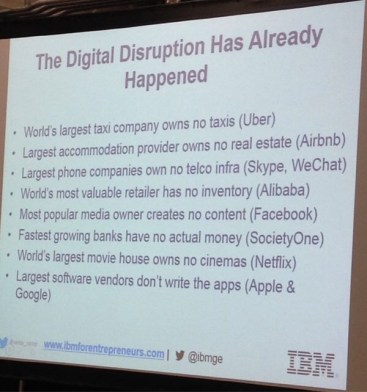
 Disruption has already happend IBM:
Disruption has already happend IBM: Source: IBM http://www.ibmforentrepreneurs.com

Disruption for many people generates discomfort, shakes the status quo and breaks routines. We all have an emotional response to this process: for some hesitation, doubt, confusion, fear, anger, bewilderment, and for others excitement, rejuvenation, inspiration, motivation and energizing or a combination of the above.

The Digital Disruption Has Already Happened”  image on twitter challenged my own thinking, and as I unpacked this with a group of students we all had to take time to unravel what this meant to us. After a healthy discussion we came to a common understanding that each of these companies generated a  “disruption” armed with ideas and models that completely reshape the economic contract of the business world. The disruption challenged a set of expectations, routines and structures, thus redefining what it means to provide a particular service. In the process,  the relationship between worker, employer, customer and their social contracts was also redefined. As these models of disruption become part of our economic ecosystem, a whole new paradigm faces us. A good example of this process is featured in this article “The Last Kodak Moment?” (Economist)

As the students and I further discussed what this means to us here in the classroom, we started realizing a distinct disconnect between the objectives and outcomes of our learning in school and the reality that this image represents. There are two worlds working in very different realms with no clear bridge creating a meaningful authentic connection between them. As one student shared after seeing this video in class, “mmm I find it odd that we are not learning how to make these things in school, or understand how they work or maybe fix them.”

Yes, the world around us is changing rapidly, very rapidly, we know this, we are aware of this, we state this, and are impacted by this daily.  However, our role is often that of the passive consumer, unconsciously sucked in by the addictive seamless convenience of the services these disruptions deliver. In our passivity and growing dependence we seem willing to sideline a more critical reflection of what this disruption is doing to us. The engines of this disruption: creativity, machine learning, algorithms, and innovation are driving the ecosystems which are quickly becoming non negotiables with our work and social flows. These disruptions are inevitable and not bad or good, they are part of today’s economic narrative that impacts us all locally and globally.

But in the bubble of “school” there is a sense that it is okay not to engage with this concretely, giving ourselves permission to continue focusing on learning objectives and outcomes tied to a past. As Michael Wesch shares in this TedTalk: From Knowledgeable to Knowledge-Able,  what we teach, what we engage as “musts” as part of the learning contract are disconnected from the pressing realities surrounding us. This lack of authentic connection and scaffolding which should provide the skills and cognitive capacity to critically engage with the rapidly changing world are watered down to suit our own educational comfort zone and established routines, which have worked so well for us in the past.

Schools are keen to talk about teaching to students’ future and as George Couros share in his book ” Innovators Mindset”, its all our future and all of us need to understand and engage with it concretely, not just the kids. Education rhetoric is rich with 21 century skills terminology and on the surface we are okay to dabble with some ideas and changes, but not at the level where we truly have taken on a deep understanding as educators about what this disruption is doing to our world and how we can act as concierges of learning. We need to ensure our students are not simply consumers of the disruption but empowered creators and active participants of the disruption.

A disruption needs to occur in schools with professional development. In a video by Frank Barrett in the Harvard Business Review “To Innovate, Disrupt Your Routine” he highlights the importance of leaders ability to engage in a process where routines are disrupted to generate opportunities for creativity. As an example he uses the wonderful analogy of Miles Davis’s Kind of Blue album and the disruption he facilitated, disrupting routines which had the group enter a discomfort and then supporting them to create something new that changed the face of Jazz.

It is often the case, and I am generalizing here, that professional development in schools is focused on pedagogy framed by comfort zones that generate no disruption, learning framed with limited clear connections to the real world, lecture style delivery, and bulleted PowerPoints squeezed at the end of a long day of work. This dynamic can generate a level of disconnect, cynicism and passivity by participants, and dilutes the connection between what we teach and how we tie learning to be authentic and connected to the pressing realities surrounding us.

School leaders need to first disrupt their own professional development. They also need to be bold and challenge their own comfort zones. Through this act, we then experience first hand the process described by Frank Barrett in the Harvard Business Review, and will be willing to mentor leadership teams and faculty to go through a similar process with explicit support and care. If we are going to lead and disrupt our routines to engage in a process where we innovate and create then educators need time, space, support, empathy, and meaningful scaffolding. With this we build the capacity to disrupt their own thinking and internalize how they can take ownership with the process. We need to disrupt professional development learning outcomes, so as to be able to craft a learning narrative connected to a world driven by a new economic reality; one framed by creativity, algorithms, machine learning and innovation. Through this process we can then facilitate a culture where educators become active participants of the pressing realities surrounding us and lead and mentor learning with authentic and meaningful connections to the world of disruptions we are living in.

We cannot expect to authentically connect our students’ learning environments with the rich tapestry of the world of economic disruptions without giving ourselves permission to disrupt ourselves first and shift our professional learning discourse to unpack, synthesis, connect and craft learning outcomes that explicitly provide meaningful opportunities for us to make sense of constant disruptive change, and from there as concierges of learning, choreograph an authentic learning landscape for students. “Disrupt me!”

John@beyonddigital.org


…leave the kids alone?

Views Czech SwitzerlandThere is a belief that children nowadays are natural, “Digital Natives”, and that we adults on the sidelines are “Digital Immigrants”.  The dexterity and comfort many children demonstrate when interacting with digital devices and social media tools generates this image of them being “naturals”. This in turn contributes to the sense of disconnect between the so called “Digital Natives” and “Digital Immigrants”.

In reaction to this sense of disconnect and divide, educators often restrict access to technology, keep the screens out of the classroom, or tightly dictate the parameters of its use on their own terms. This is often done in an effort to dampen the disconnect we feel when trying to understand the students’ perspectives.

Often, parents and teachers express a sense of having to “catch up” or “keep up” with children’s adeptness at using digital tools and environments. There is a feeling that a race is on, and somehow as adults we have the odds stacked against us.

Children are not born digital natives, they are born digital consumers. A child’s first encounter with digital devices and environments will be framed by their parent’s digital use: a mom walking with the stroller whilst talking on her phone, listening to her music player, or checking a social media post; a father texting while giving his child a bath; parents watching a video on their tablet, searching on their phones as they feed their child, checking email or wall posts while their kid watches from the stroller at a restaurant. These daily routines are part of our growing fractured attention – being here but actually somewhere else. This behaviour quickly frames the context and role of the devices in our relationships, as well as their role in communication and day to day actions. Children from a very early age are the audience to our digital behaviors. Children start constructing their own understanding of digital devices and their role in response to our actions. They use this experience as a guide, most often subconsciously at a young age, and ultimately frame their own interactions based on what they have seen.

As children start interacting with the digital devices, be it on their own or with ones shared by a sibling or parent, they are in consumption mode. This consumption often becomes the source of their relationship with these digital devices and ecosystems – playing a game, watching a video, chatting, posting, and searching. Often the experience can be a solitary one, disconnected from physical reality. The device becomes a babysitter, a tool to give parents a break, or an opportunity to allow us to have a split attention.

Yes, so-called digital natives are very adept at using devices and quickly working out the tools they provide. The strategy is one of press, try, press, click, try again. They have a sandbox mentality when it comes to exploring technology. Anything is okay, as long as the child is making progress. It is this blind capacity to forge ahead, try, and try again with a fail forward philosophy that throws us off as adults. For many of us, the point of reference is a more linear approach to problem solving, working sequentially and sometimes with more hesitation than blind confidence.

This difference should not be our exit card from the need to engage with children and digital device use. We as adults have a responsibility to be active participants in the digital device journey of children, both at home and at school. We have a responsibility to choreograph concrete strategies where we become active participants and guides. This starts with us understanding and being mindful of our own use, and how digital devices are tethered to our day to day workflows. We need to consciously reflect on how our own behaviors frame the context of digital device usage for our children.

The social media and digital ecosystems we have are the environment of our age. Throughout time there have been repeated instances where new technologies come into play, and a generation gravitates to these. This divide between the current generation of users and adults is one that has occurred time and time again – with the telephone, the radio, and television, just to name a few. The process of learning and adapting to these new cognitive interactions is part of being human. We frame our use of technology on human emotions, understandings and aspirations. Our role as mentors, educators and parents is to nurture these human emotions, as well as the aspirations of our children, as active partners.

As adults, being a proactive partner in learning with a child creates a rich opportunity for both to understand the shared experience. The partnership provides language development through the conversations between the adult and child.  Unpacking the context together and developing an ability for questions and comprehension is part of the process we use to construct new understanding. For adults these are precious moments. With our own development of this relationship, we scaffold a vital critical thinking experience for the child. This gives us a unique opportunity to understand the child’s experience. Throughout the ages, the sharing of knowledge and experience between adult and child has been an essential part of the building blocks of relationships between different generations.

Moving kids away from a consumer model with digital devices requires guidance and inspiration. What they are doing and how is more important than what digital device they are using. As adults, we can curate these experiences and provide inspiration by modeling less of a swipe and point consumption philosophy. By doing so, we would encourage children to engage with critical thinking skills through creative content and inspire them to get excited about creative problem solving.

With our society’s nearly ubiquitous access to digital devices, why have we as adults disengaged with the changes? Is our own digital consumption numbing our ability to find inspiration? Parenting is still parenting, be it in an online or offline environment. Children are still children. It boils down to our willingness to carve out the time. The world does not need a growing population of digital devices consumers. The world we live in is hungry for critical thinkers who are engaged in creative problem solving and in leveraging digital devices and ecosystems in a way that might create a more connected society.

John@beyonddigital

Our Connected Data

unlearning learning
.

Over the last few weeks, an outstanding series produced by ARTE called “Do Not Track Me” has become available and is getting quite a bit of social media attention.

The different episodes explore and highlight the technologies, algorithms, data mining and aggregation of our online information through digital devices, tools, ecosystems and environments. Each of the episodes breaks down the architecture and rationales of companies, organizations and governments tracking in an interactive manner and examines how this impacts our privacy and digital footprint.

For many of the pre-internet generation, privacy both online and offline is an important right. Having full control of our privacy and being able to independently curate and choreograph where our information is and goes is an expectation. Naturally, there has always been an aspect of our information which we have not controlled, but in general, the collective expectation in most democratic countries has contained a certain level of privacy.

A paradigm shift has occurred in the last decade initiated by many companies realizing that instead of generating income from only paid advertising (remember pop ups?), they can also keep track and personalize their users’ internet experiences to generate far more valuable information, which can then be leveraged into an income. The incomes generated from a personalized web (where you get search results, ads, and information that is tailored to your tastes and based on a saved history of where you have been) are impressive. This interactive live stream shares the incomes generated by internet companies in real time.

We each are generating information that contributes to Big Data: large sets of aggregated information which we each create as we interact, live and work in the Internet’s ecosystem. Every click,”like,” scroll, connection, purchase, browse, download and action generates a footprint. This tracking and aggregation of our data is done on all of our devices connected to the internet and/or cellular networks. (A video that unpacks the technology behind tracking information)

There is no doubt that some of the tracking taking place is positive and provides us with certain efficiencies including a more tailored online experience. On the other hand, there is also a large amount of information that is collected without our knowledge which does not add to our browsing experience.

For many of us the convenience of a frictionless experience with our digital devices, tools, and environments is a huge plus. For this frictionless experience, many of us are willing to give up a level of our privacy to third parties. After all, a convenient and seamless experience is the key for users. Nowadays many of the actions, processes and uses we engage with on digital devices, tools, and environments are almost subconscious actions. Our usage is so embedded in our daily routine, both social and professional, it becomes a non-negotiable part of our life.

With this precedent, we have entered a world where personal information aggregated over time is combined, analyzed and then generated into a longitudinal profile of us. This rich set of information is then sold, traded, and curated by organizations, governments and companies. It is from these information landscapes that services and products we might need can be accommodated or altered based on our profile.

The question of course, is what our world will look like as every single digital device, tool and environment is consolidated, monitored, aggregated, and analyzed over time. Yes, maybe you could try to opt out, but it is unfortunately becoming harder and harder to do so as the internet becomes more integrated with our culture. Commerce, social media, communication, socialization and work have all moved to an online environment 24/7 in most parts of the world.

Does it matter? Are our online profiles and habits a true reflection of who we are? Does this aggregated information sold, traded, and curated by companies and organizations provide us with services and experiences that supersede the erosion of privacy? Either way, the discourse is clearly an integral component of our connected data experience.

“Most human beings have an almost infinite capacity for taking things for granted.”

― Aldous Huxley, Brave New World

John@beyonddigital


Stop Pretending in Education

In education, we have to stop pretending that

  • there is a separation between the digital world and the real world
  • all students have an excellent understanding of digital tools and ethics
  • technology is a learning outcome and not a tool
  • failure and open ended outcomes are bad
  • we are not in a state of constant accelerated change

Scott McLeod challenged others to participate in a conversation on how to #makeschooldifferent with the prompt “… we have to stop pretending”. In this challenge, I’d like to invite @pgreensoup  @jasonohler @arniebieber  @russiazurfluh

Control Room

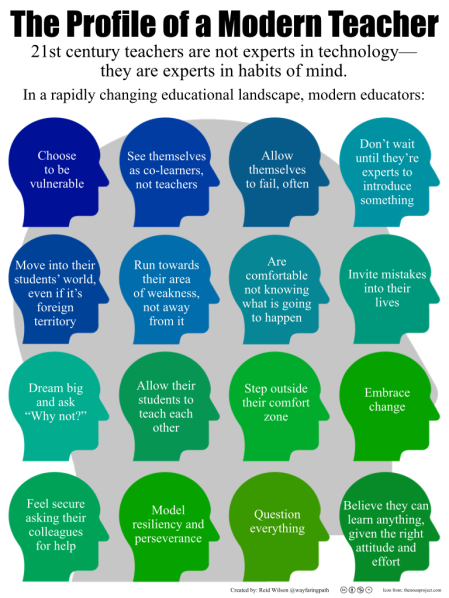
=The-Profile-of-a-Modern-Teacher
Used with permission from Reid Wilson: http://www.coetail.com/wayfaringpath/

I caught a tweet about Reid Wilson’s post with this infographic and it simply jumped out at me. It got me thinking about my own learning. The idea of letting go, being open, okay to mess up, explore, tinker and celebrate being vulnerable and taking advantage of  my failures as a learning opportunity. The habits of mind Reid shared resonated with me. The powerful infographic highlights how in today’s rapidly changing world habits of mind are critical in engaging with these changes. Reid Wilson‘s  infographic does a wonderful job of challenging educators thinking and push one to reconsider the pedagogic discourse of learning in schools.

The important premise is that these new habits of mind are about educators cognitive capacity to build new frameworks with a significantly different set of behaviors and beliefs connected to a world that is in a constant state of accelerated change.

There are some concrete outside forces which come into play challenging our learning communities. The shifts caused by these outside forces are significant and only highlight the importance of seriously engaging with Reid Wilson‘s premise.

One of the biggest shifts is how the work place, employment and jobs are radically changing due to the adoption of new technologies and more importantly a break from traditional business models.  Examples like Air B and B, Uber, the apps market and the rash of start ups fueled by the E-economy are re-framing employment rules in the work place. The dynamics of this shift are nicely broken down in this article: Workers on tap @Economist. A whole generation of students in schools today, are entering a new work place being choreographed by these changes.  The social contract of employment we have lived with is being turned upside down.

If tools can be emailed at a click of a button (Nasa emails spanner to space station @BBC) and constructed in the confines of our homes with a 3D printer. How does that shift the dynamic of manufacturing and in tandem the role of design, location, innovation and production. As this develops we are seeing a re-framing of manufacturing, and it will not be about location but innovation, creativity, flexibility and adaptability.

The growing field of machine intelligence and the complex dynamics of the ethical implications are starting to challenge our own moral construct and the relationship between machines and humans. Shivon Zilis shares out an interesting graphic on her blog (the Current State of Machine Intelligence.) that delineates the companies and organizations involved in machine intelligence and the accelerated growth of areas unheard off a few years back. The growing investment tied to the development of machine intelligence coupled with the field of “learning machines” as described by  Jeremy Howard’s Tedtalk  are ushering a science fiction like future which actually is being constructed today!

These are just a few of the many new shifts changing our world, and being unpacked before our eyes. A term which encapsulates these forces well, is VUCA, an acronym for “volatility, uncertainty, complexity and ambiguity” initially coined as a military term in the 1990’s and now often shared in the context of companies and organization engaging with a variety of  leadership frameworks.

Schools and education leaders are in a unique position to engage, lead and model Reid Wilson‘s  construct of the 21 century habits of mind in response to the forces of accelerated change. Education leaders must be risk takers themselves and engage with the responsibility to scaffold, curate and facilitate this new construct that prepares not only our students for a world  of “ volatility, uncertainty, complexity and ambiguity” but the educators that are in the control room of learning.

John@ http://beyonddigital.org

Special thank you to Reid Wilson for sharing the graphic. Do make a point of checking out his blog:  http://www.wayfaringpath.com/

The Death of ” Digital”.

Santa Cruz California

Words are a powerful vehicle for meaning and understanding,  connected to individual or group perspectives, interpretations,  and connections. The word “Digital” has been part of our vocabulary landscape for a long time.  It was only after reading Nicholas Negroponte’s  book, “Being Digital” in 1995, that I began to be aware of the term and its impact on the world to come, but in 2014, the word “digital”  has now blended itself into the daily fabric of our lives. When we think of the word “digital”, it creates a sense of disconnect from our world and implies that the digital world is a separate part of our reality. However, this is no longer true. Our lives are so embedded within this digital realm that the two have become inseparable. So, I invite us to use a new set of vocabularies to frame this paradigm:  Appliances, Utilities, Information Flows, Ethics and Algorithms.

Appliances are the consumables that we connect and interact with (laptops, phones, tablets, GPS, and other hardware). These tools have become the default to our connectedness; disposable and with each new version more seamless, simple and integrated.

Utilities frame our day to day interactions. These social medias, networks, email, RSS, professional learning networks and Web 2.0/ 3.0 tools have become the architectural  framework of communication and information for our connected world.

Information flows are the 150,000,000 Blogs posted a year, 5 million tweets per day, 200,000 videos uploaded on YouTube daily, and the petabytes of information created, aggregated, shared, and circulated daily around the earth.

Ethics is the why, how, when, where and who of our digital footprint in today’s world. It is the wide ranging issues from Killer Robots to the impact of a Filter Bubble (where search, news, and information algorithms choreograph what information types we get based on our personal browsing habits). The curation of our online and offline privacy as governments, corporations, and organizations juggle a treasure trove of information created by our respective digital footprints, is the new ethical dilemma we all deal with, as individuals, groups and as societies at large.

Algorithms are the backbone to the intelligent softwares that inhabit the engine of the internet. These are predictive, anticipatory, intelligent and analytical. The are the lifeblood of the internet ecosystems for individuals, governments, corporations, and organizations which then create, develop, build, facilitate, monitor, analyze, synthesize and evaluate our day to day interactions. The algorithms have become the life line to the information flows, ethics, utilities and appliances.

These words are not the definitive list, but reflect a vocabulary we use both from our past and present. They highlight how the “digital” world is ingrained in our daily lives, to the point we often are not even conscious of its presence. This connectedness fueled by our devices and ecosystems now are part of the fabric of our lives, often out of our control, and a non negotiable aspect of our own participation with the day.

A critical understanding of these words and their respective dynamics should be an essential ingredient in School and Organizational curricula. We can no longer think of them as separate entities. We have inherited this reality which now has us connected in ways where opting out becomes the abnormality . These Appliances, Utilities, Information Flows, Ethics and Algorithms are part of the fabric of our world and impact us as humans both consciously and unconsciously.

This discourse needs be given equal time in all educational settings; imbedded as seamlessly in the curriculum as they are in our lives. A responsibility to highlight the power, richness and cautions that come with tying ourselves to a set of appliances, utilities, information flows, ethics and algorithms that have and will continue to change the fabric of our interactions as humans and organizations.

So how do we do this? The key is that these terms and their meanings are introduced as part of the learning landscape in all units of study. Creating authentic connections between these words and the learning environment will then scaffold a clearer understanding of their real world applications. In our school ecosystems most subjects and curricular areas are using technology, often as a separate tool, or as a side show, but, if it is so seamless and embedded in our day to day lives, then we need to translate this into our learning. One of the first steps is to give ourselves permission to change the way we work with this vocabulary. As we change the vocabulary, and with it the meaning and role of these words, we are engaging in an active learning process connected to the changing world.

To ignore this vocabulary is to short change future generations of their awareness of a world that has become more invisible, seamless and blended both in our conscious and unconscious day.  The death of “digital” is here.

John @beyonddigital.org


There is a needle in the haystack, Ground Control.

All of us are engaged daily in the process of looking for information on the Internet, or “searching“. Sometimes, we search for clarification, facts, confirmation, projects, solutions, while other times our searches help us broaden our views, come to terms with a concept, make a plan, find a definition, or cross check a fact. Watch yourself or a friend at your next social function. Someone is bound to pull out their portable digital device (phone, tablet and/or computer) before long to make sure something that was said is correct. They might look up an actor, a city, an album, a song, a title, or an author. This is now part of our daily digital diet: a quick hop onto our device and off into the Internet to “search” for information.

  • 51 million – Number of websites added during the year.
  • 1.2 trillion Number of searches on Google  in 2012.
  • 43,339,547 gigabytes are sent across all mobile phones globally everyday.
  • Humankind in 2007 successfully sent 1.9 zettabytes of information through broadcast technology such as televisions and GPS. That’s equivalent to every person in the world reading 174 newspapers every day.
  • There are 5 million tweets per day enough to fill New York Times for 19 years.
  • Humankind shared 65 exabytes of information through two-way telecommunications in 2007
    That’s the equivalent of every person in the world communicating the contents of six newspapers every day
  • 58 – Number of photos uploaded every second to Instagram.
  • 5 billion – How many times per day the +1 button on Google+ is used
  • 1.3 exabytes – Estimated global mobile data traffic per month in 2012.
  • Bloggers post 900,000 new articles everyday.
  • Over 210 billion emails are sent daily which is more than a whole year worth of letter mail in the USA.
  • Daily around 200 000 videos are uploaded on youtube which will require over 600 years to view them all.

(Source: Economist  The World 2013 and Internet 2012 in numbers by Tech Blog Pingdom and Science Daily: How Much Information Is There in the World? Feb. 11, 2011)

Information grows from Terabyte to Petabyte . As a human race, we cannot actually view, analyze, or keep track of all the information we generate without third party digital tools and softwares. We now defer to sophisticated algorithms and intelligent softwares to store, track, synthesis, analysis, aggregate, and deliver information in amounts we have the time and capacity to digest. And most of us today expect to have this information available non-stop, over multiple devices.

Information overload, information stress, information pollution and information anxiety are part of the narrative of the digital age. With the amount of information increasing at accelerated speeds, we have relinquished any control we once had over its exponential growth. What we need to do is develop strategies, skills and understanding on how to filter, sift, analyze and juggle information, so we feel some level of control.

As we embed ourselves in this vast information landscape and wish to remain critical thinkers, we need to be ready to retool ourselves:

  • Coming to terms with the “Filter Bubble : this is where information is processed and delivered through algorithms based on what our viewing and search habits are, thus filtering information to our perspectives and not providing alternative views and information. The balance of information is vital to building a broad understanding of different views. Nowadays however, through the “Filter Bubble, this balance is being diluted. We need to understand this and be able to counter it as critical thinkers.
  • Developing a strong searching expertise:  We need to understand the capacity of search engine tools, their variables, and limitations so we can refine and sift information in a manner which gives us manageable amounts of results.
  • Be able to Aggregate:  Learn how to leverage news aggregators, real time syndication, social media, micro blogging, and social bookmarking sites.  These tools can help in sorting different formats, cull large amounts of information and deliver it in digestible portions for us to develop new capacities.
  • Engage in Connectivism: A learning theory constructed on the idea we can learn with digital, social and cultural connections, and from this interchange build individual and/or collective capacity to gain knowledge and understanding. Through our social and professional connections create networks of expertise, knowledge, and understanding to support learning. Use the “cognitive surplus” we have available in our social and professional groups to increase our own knowledge so we can create, communicate, produce and share effectively as critical thinkers.
  • Learn, unlearn and relearn: We need to develop the strategies and methodologies that allow us to engage effectively in this process of “learning, unlearning and relearning” daily. In tandem, we need to ensure that everyone has the opportunity, support and resources to do this.

From this point forward, there is not going to be any less information – that is a fact. As the world moves into a state of constant change, and the pace accelerates, we have a responsibility to ourselves, our peers and our communities to make the process of learning, unlearning and relearning permanent. If we do not, we could potentially lose our ability to participate as critical thinkers and control the information landscape we live in.

John@ http://beyonddigital.org

Where is the manual?

where is the manual?

When is the last time you opened up the manual from some device  you purchased, sat down and went through the pages to become familiar with your purchase? The chances are a long time ago. To be honest nowadays often items do not come with a manual at all.

This last week we had the pleasure of having Jason Ohler visit our school and work with our parents, students and faculty. One statement that stood out during the day was Jason‘s reference that a sign of intelligence is not how much knowledge you have, but one’s adaptability to learn, unlearn and relearn.

Our students often have a lovely capacity to sit down and just click around a device or software and through persistence, trial and error work things out gradually using the learn, unlearn and relearn strategy at an accelerated pace.

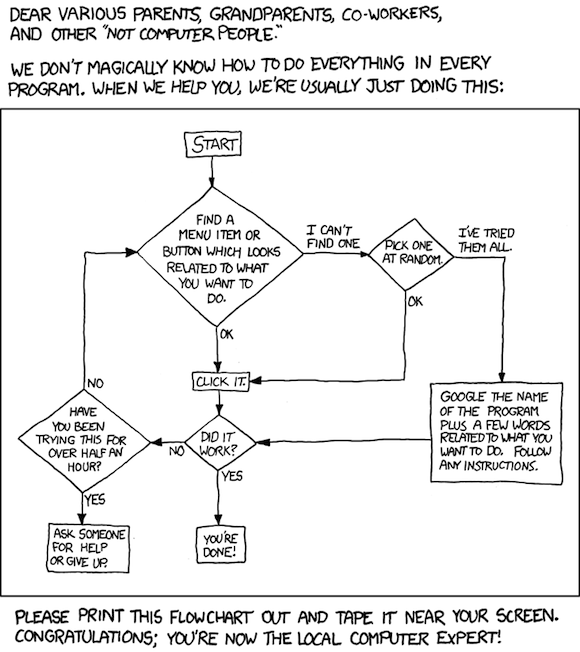
With the sheer volume of online videos, online FAQ, reference sights and web resource available at the click of a mouse it is still surprising to see how many adults need to filter their learn, unlearn and relearning through another person. Somehow for many in the education world, we are quick to engage with the idea that students should be independent learners, work things out on their own, and be able to breakdown complex tasks and create understanding from this process by troubleshooting independently. But then when it comes to us, we seem to loose the capacity to engage with these same attitudes. I witness daily adults confronted in having to work out a problem or go through steps to understand a process or procedure automatically looking to another adult for support.

There is no doubt that the culture of learning many of us have as a frame of reference is one of the sage on the stage, and the expectation and need for all our knowledge and learning to go through such a filter. Granted often it is easier to ask someone to find the answer for you then take the time to do it yourself.

Why?

I believe that many adults are not equipped with the tools or skills to be able to take advantage of  the rich mix of resources and mediums available via the internet 24/7 to  learn, unlearn and relearn.

The reality we face not only in our schools, but globally is there is a dramatic shift in what skills and jobs are pertinent for the new global economy. The tragedy is that for many who have worked and lived in a world where they were able to survive on one skill has disappeared. The throngs of unemployed around the world will not be finding the same jobs as many pundits keep reminding us. The only option, and the challenge both emotionally and logistically, is how does one engage with this bitter reality of being jobless, and find the capacity to engage with the learn, unlearn and relearn concept.

It is not really our students that need the mentoring with this, they have got it to a certain extent.  They have grown up in a world where there has been no manual for the devices and online environments they live with. If they are not sure they go to either Youtube, or click around till they bump into enough things to construct their understanding.

The concern is if we have a generation of adults currently who are adverse or not sure how to go about learning unlearning and relearning, mentoring our students and peers we are setting ourselves for some tough times. The world has moved on, and to sit and always expect your company, school or organization helpdesk to have the answers to everything is avoiding the reality that each one of us has to become our own helpdesk. This needs to be the non negotiable under current in our own professional learning communities.

John (beyonddigtal.org)

this carton shared by pgreensoup from Keith Ferrell

The success of failure

I am convinced as educational institutions we do not celebrate and nurture failure enough. Our days are so centered on highlighting success, and drilling into our students and faculty minds, that success is the measure which validates the time and effort we put into each of our days.

Life’s and the world problems are messy, inconsistent, unclear, and more importantly do not come with clear solutions. Sometimes there are no solutions! This is the reality many of us walked into once we left school.  Each of us has built capacity to learn and deal with this differently and the learning occurring in the motion of confronting the problems. Future generations of students will and are heading out of the school gates into this dynamic.

An acquaintance shared with me a perspective a few Venture Capitalist work with before investing into start ups. They look how many times a potential group/organization has failed in trying to start something, and the more failure they have experienced the more likely these Venture Capitalist will invest in them. The premise is that from each failure, there is significant learning that takes place, and as you build on this learning, and fail again, you increase your capacity to deal with the next set of problems. Through this process and engagement you as a group/organization are more likely to succeed with your idea. A key ingredient tied to this premise is the level of tenacity, passion, and belief you engage with as a group/organization in confronting multiple failures and what learning/lesson you build from this to then deal with the next challenge ahead.

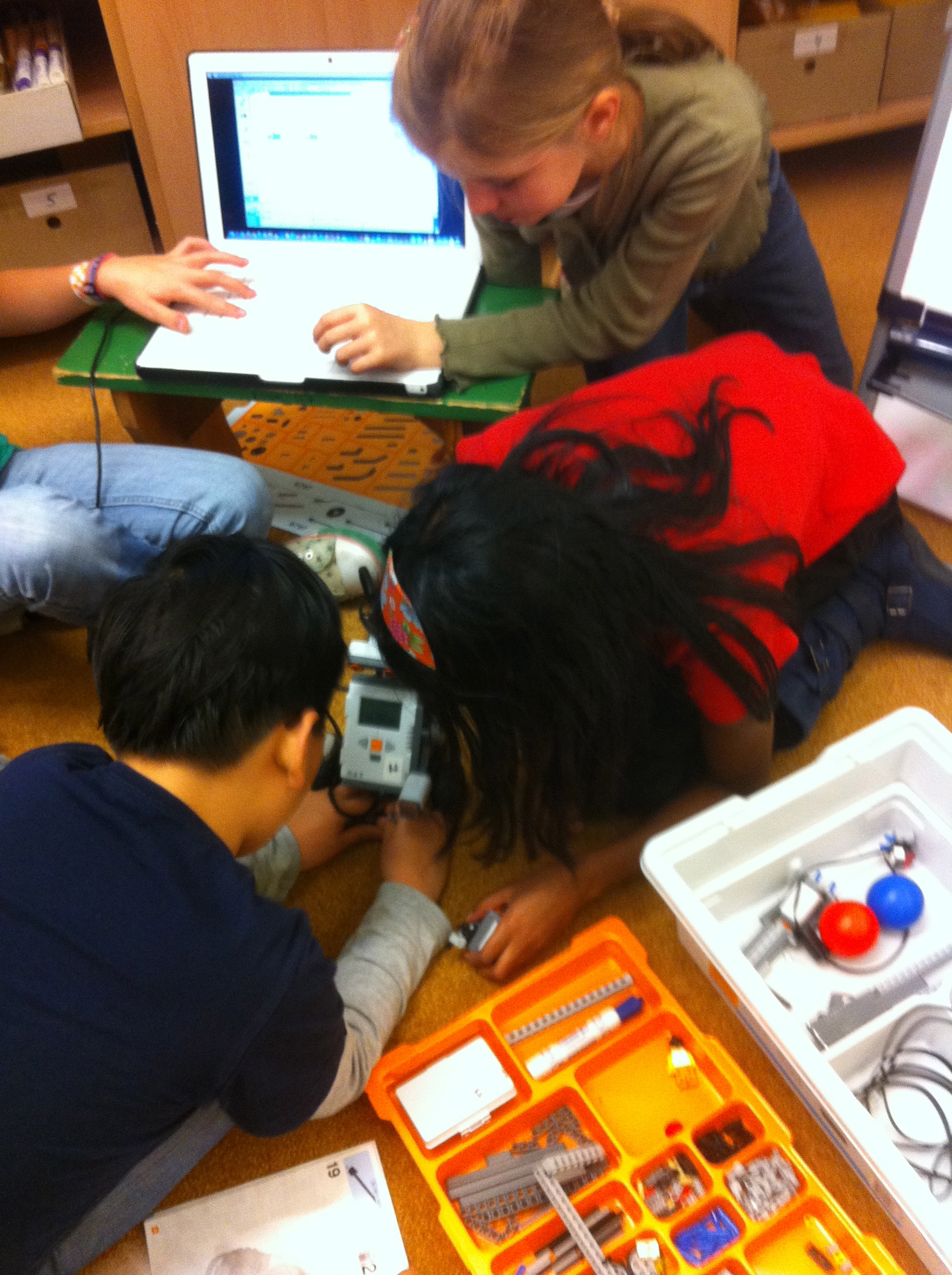
A group of students pictured above working with Lego Mindstorms, faced an issue with the version they had installed on their laptops. The Lego Mindstorms software was not fully compatible with the MacOS version running on the laptop.  Lego Mindstorms had not updated some of the drivers to work with more recent version of the Mac OS they where working with. The problem they faced was some functions required you to tap, click multiple times, sometimes it worked and sometime it did not. Their solution  just tap/clicked till it worked, and before long they understood how many taps/clicks they needed for the function to work. This they integrated  into their collective problem solving and moved on. They continued to come across glitches. They adapted each time a set of strategies to work around the failure with one goal in mind to have their robots do some movements and tricks. Even though things took longer, often requiring restarting the computer, or clicking non stop, it became part of their workflow and solution to a messy problem. The passion, tenacity, and collective energy had them, even thought failing quite a lot, over come the problems and learning a little more little by litte to program the Robots to move and do tricks. Their goal and measure of success.

A group of International School students taking part in the European Student Film Festival Challenge came to a roadblock. Partly to the fact that these 6 individuals had never worked together, some where from different schools, different countries and cultures. The dynamics in front of them was pretty much one problem after another, coupled with the pressure of being in a timed challenge. They gradually unpacked things slowly, each step faced with a level of failure, but giving them a better understanding of the other group members potential. The setting for their collaboration was around a set of chairs with a chess set in the middle, which often saw them fiddling with, as an outlet to their nervousness and stress. The only common ingredient they all brought to the group, was each was passionate about Film. Individually they knew they each had a set of skills that could contribute towards their challenge. Surrounded by the discomfort of hesitation, false starts, juggling opinions, different individual needs, unpacking the parameters of the challenge, translating it into something concrete they all could move forward with. 24 hours later below was the result.


Czechmate used with permission from Julien M.  A collaboration and joint production by Begum E., Ema E., Jerome B., Julien M., Lenny M., and Oliver Z winner of the European Student Film Festival Film Challenge Excellence Award.

We should stop and celebrate failure within our groups/organizations more often than we do. Make it part of every learning experience. Invite ourselves to focus on the unique learning which failure can bring to our reflections, ideas, and ability to overcome the messiness of problems we face and will face. If our respective communities spent more time taking apart the failures we experience, look at each moment, see what components are in play, give us opportunities to do things differently than before. This can be the celebration of our collective learning from which we build our successes.

John
http://beyonddigital.org