Is It Ever Too Early to Learn?

“She is always there. She never says no. She always has a nice voice.”
A Year 3 student, when asked why she likes her home voice assistant

This moment in the classroom, with students sharing what they liked about their home voice assistants, highlighted for me why it’s never too early to start teaching digital and AI literacy in schools.

In many classrooms, conversations about AI can tend to happen more in middle or secondary school. Educators often feel the tools are too complex, or the ethical discussions are too advanced for younger learners. Over the past two years, I’ve had the privilege to lead and facilitate many workshops with international school leaders and educators, and in many cases, the conversations seem to focus on ages 12 and up. But in my experience working with students aged 3 -11, this is a misconception.

Children are already surrounded by the digital world long before we introduce it formally at school. They see their parents on their phones, talking to Alexa while cooking dinner, asking Siri for directions in the car, or using AI-powered chatbots on social apps. These situations are more common than we often realize, and are their first interactions with artificial intelligence. And they’re happening at home, often with little guidance and few conversations explaining what’s really going on.

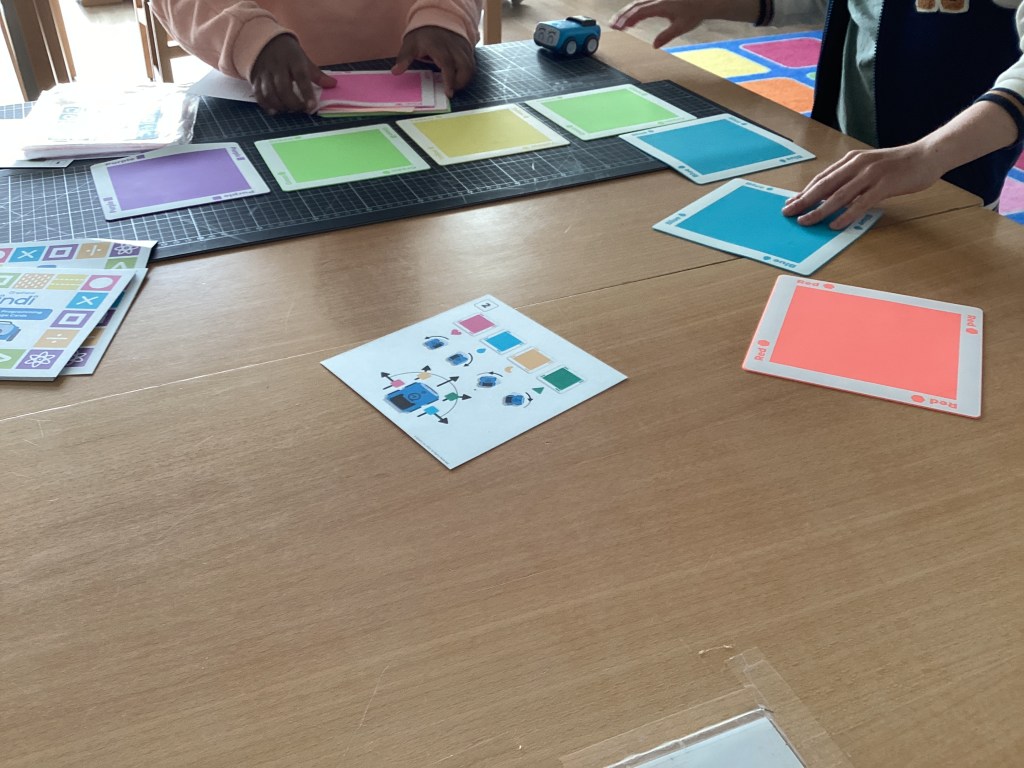
Even the  youngest students can begin to explore some of the key ideas behind AI. In early years classes, I start with pretend play and simple cause-and-effect activities using tools like the Sphero Indi robot. I use colored tiles to predict what the robot will do, opening conversations about instructions, sequences, and how machines “learn” from information they are given.

With students in Years 3, 4, and 5, I explore concepts like algorithms and personalization. Many are already using YouTube or even TikTok and can easily relate to how one video leads to another. I ask: Why do you think that video showed up next? Who decides what you see? These questions open up conversations about algorithmic predictions, bias, and the importance of pausing and asking questions.

I’m seeing more upper primary students, ages 10, and 11, using AI apps that simulate conversation or even friendship. Apps like My AI on Snapchat are often mentioned when we talk about what’s behind a chatbot. I create activities that help students reflect: Is this a real friendship? How is it different from talking to a friend at school?

Helping students understand that machines don’t have feelings, even if they sound like they do, is an important step in their learning. I explain that AI tools are run by algorithms, step-by-step instructions written by people. These tools might sound kind or caring, but they don’t think, feel, or care. Research shows that young children often believe voice assistants like Alexa or Siri can feel or understand. That’s why, in age-appropriate ways, I explain how AI systems are trained, how they collect data, and how they can sometimes get things wrong. I help students make the connection that, just like them, machines also make mistakes, but for very different reasons.

I then connect these ideas to hands-on experiences. Students code and create using tools like Indi Sphero, Bee-Bot, LEGO Spike Essential, and Ozobot. These activities help children see how giving clear steps to a robot is similar to how smart tools at home follow instructions, helping them understand that behind the “smart” behavior is a set of human-written rules, not real emotions.

I also explore:

  • Misinformation: We talk about what happens when someone shares a lie. What does it feel like? What’s the problem when this happens? Why do people lie? How does it make others feel?
  • Bias: We look at image searches on search engines and AI image generators. We ask: What do we notice when we search for “teacher” or “doctor”? Who’s missing? How might this be different from your own experience?
  • Media Literacy: Students create their own fake headlines or altered images, learning firsthand how easy it is to mislead others, and how important it is to ask questions.

Digital and AI literacy isn’t just about understanding how technology works. It’s about building habits of critical thinking, empathy, and responsibility.

In a Primary Years Programme setting, and the same applies in other curriculum contexts, we already emphasize critical thinking, empathy, and action. These values align well with conversations about AI ethics. When students understand why it’s important to check sources, think before they share, get more than one perspective, and reflect on how algorithms shape what they see, we start to provide them with a toolkit to navigate the digital world with care.

This is especially important as AI becomes more present in their daily lives, often in quiet, seamless ways. The child who turns to Alexa because it’s always “available” may not yet realize that real relationships are built on kindness between people, not just what’s easy. But for that kind of learning to develop, a teacher is essential.

Some of the learning I engage with:

  • EY, Y1, Y2: Explore pretend play, altered photos, or “real vs. not real” objects. Use simple language like “true” and “trick” to start conversations about misinformation.
  • Y3, Y4: Introduce recommendation systems through YouTube or Netflix patterns. Encourage questions like: Why does this keep showing up? Who decides what I see?
  • Y5, Y6: Dive into algorithms, AI-generated text or images, and ethical questions around chatbot use. Use inquiry units to explore bias, authorship, and media influence.

This is a shared responsibility that all educators need to support one another in. And as school leaders, we need to create the time, space, and understanding that respects that every learner, child or adult, connects with learning in a different way.

In a world where AI is becoming part of students’ daily experiences, our responsibility is to design purposeful activities, building the students’ capacity to ask helpful questions, notice things, connect ideas, and make careful choices

On a recent episode of the podcast I host, one guest, an AI EdTech entrepreneur, was candid: “Not teaching and engaging with AI literacy in schools is pedagogic malpractice.” A strong statement. I see it more as an invitation, a reminder of the opportunity we have to be present in this moment. Amongst all the demands teachers manage each day, we can still find meaningful ways to ensure primary school students build the knowledge, skills, and values to engage with a world that is only becoming more complex and nuanced.

I am grateful to my PLN for all the sharing, resources and ideas I get to learn from. A special shout out to Cora Yang and Dalton Flanagan, Tim Evans Heather Barnard, Tricia Friedman and Jeff Utecht who continually share generously resources and strategies targeted to Primary age students.

Resources Referenced

a letter to artificial intelligence

Sapin Simon Switzerland Photo John Mikton

Dear Artificial Intelligence

2025, this will be the year whatever I write—you will have your imprint and input on it. Be it for grammar, syntax, spelling, brainstorming, or just checking if something makes sense, questions, the sentence flow, etc. All communication, writing… mine and around me you will be there. So this one I am doing alone, my spelling, sentences and ideas might be fragmented with errors, but for this time I am fine with that.

I get it, things are changing very fast and I should get used to it. I do try to keep up, read, search, connect and even teach about you, but there’s so much.

You have changed my day… okay will also give credit to your nine creators—four in China, five in the U.S.— designing and choreographing: your power, your capacity when and where you show up. I get the sense they are all in a race  – control, power, profits… and leave the ethics and regulation for others to guess and deal with. 

I’m not against you, I appreciate all your tools and capacities that I use; they’re amazing. I so appreciate the positives in science, medicine— again reminding me of your benefits. I hear this year you get to help me even more as an agent, an autonomous synthetic personal assistant that can do tasks for me, that is clever and I am curious. You continue to seduce and fool me at the same time. Just yesterday you showed up on my feed as an influencer, with millions following you. I will be honest, I thought you were real. I tell you it’s just becoming more difficult to know who is who, or what?

I get it harvesting my life, is the cost for using you. Oh I wanted to tell you that someone who really likes you are my students. They tell me you are reliable, do not get angry, have immense patience…always happy to answer their questions whatever they may be. They have been seduced.

I keep noticing daily you show up somewhere new, sometimes it‘s obvious and at times I have no idea …. not clear who is checking up on you. So many models and versions of you. This claim about alignment and guardrails, but not convinced they always work. I get the sense that to thrive you need an open unregulated space, only answerable to yourself and the companies creating you…. They say there is no manual, and no one is really sure how you work. Really?

I need to pinch myself to make sure I understand my reliance on you? The fact that you struggle and do a terrible job of being unbiased and non-racist. This sucks. Then your whole deepfake -cyber crime and helping bad actors thrive. You need to know people are getting hurt…your darkside is so dark. 

I try to tell myself you are another innovation, like the web, search, smartphone or social media. Sorry to tell you, you are quite different. You understand me, our interactions feel frictionless. Okay you do say odd things, at times, it is like if you were hallucinating. Fact: you are not 100% accurate. That said, when it is me and you interacting…I forget alot of this…. even if you keep everything I say or do for yourself.

I have said this before,  I do appreciate you — and so helpful. I get it for all this to happen: you need a huge diet of algorithms. The whole nuclear energy thing your companies are into, just feels wrong. 

You’ve had my attention for a long time—scrolling, reels, notifications, binge-watching—but now you tell me that’s not enough. Now you want my intentions. That feels more intrusive, more unsettling. You want to know me better than I know myself. Do I really have a choice?”

Thank you
John

Reference: 
C​​oming AI-driven economy will sell your decisions before you take them, researchers warn
https://www.cam.ac.uk/research/news/coming-ai-driven-economy-will-sell-your-decisions-before-you-take-them-researchers-warn
Co-Intelligence: AI in the Classroom with Ethan Mollick | ASU+GSV 2024
https://www.youtube.com/watch?v=8FnOkxj0ZuA
Unmasking Racial & Gender Bias in AI Educational Platforms
https://www.aiforeducation.io/blog/ai-racial-bias-uncovered
AI automated discrimination. Here’s how to spot it.
https://www.vox.com/technology/23738987/racism-ai-automated-bias-discrimination-algorithm
Deep fake Lab: Unraveling the mystery around deepfakes.
https://deepfakelab.theglassroom.org/#!
Nine companies are steering the future of artificial intelligence
https://www.sciencenews.org/article/nine-companies-steering-future-artificial-intelligence#:~:text=Webb%20shines%20a%20spotlight%20on,%E2%80%9CBAT%E2%80%9D)%20in%20China.
How School Leaders Can Pave the Way for Productive Use of AI
https://www.edutopia.org/article/setting-school-policies-ai-use
Generative AI: A whole school approach to safeguarding children
https://www.cois.org/about-cis/perspectives-blog/blog-post/~board/perspectives-blog/post/generative-ai-a-whole-school-approach-to-safeguarding-children

“AI in Education: 18 Months Later – Learning, Ethics, and Opportunities”

I had the privileged to facilitate this webinar for The Educational Collaborative for International Schools: ECIS and #ISLECISLoft with Nancy Lhoest-Squicciarini titled “AI in Education: 18 Months Later – Learning, Ethics, and Opportunities”. The guest where Kelly Schuster-Paredes co-host of the Teaching Python podcast- educator and Ken Shelton, presenter, educator and author. Two people who I have immense respect for and who bring a broad depth of knowledge and experience to this topic. Their respective insights generated a rich platform for the breakout room conversations between participants attending the webinar.

The webinar highlighted the significant impact of AI and Large Language Models (LLMs) on teaching approaches, creating opportunities for personalized learning, tailored feedback, and improved workflows for educators. These AI tools creating opportunities to amplify student engagement while also bringing about challenges, such as integrating innovative with traditional teaching methods, ensuring equal access, and re-evaluating assessment practices, to name a few.

Both guests emphasized the importance of addressing ethical concerns like bias, plagiarism, and privacy. More schools are realizing the importance of establishing guidelines for responsible AI use to mitigate biases, address academic integrity, and safeguard the privacy of both students and educators.

Our guest underscored the vital role schools leaders need to take on to ensure transparent communication about the role of AI in education and the critical importance for staff to have professional development in digital and media literacy. Creating professional development that equips educators to effectively integrate the learning opportunities that these tools can bring to the classroom, has to be a non negotiable. Schools need to design inclusive environments where the advantages of AI-enhanced learning are transparent and accessible to the entire school community, including students, educators, and parents.

A special thank you to Kelly Schuster-Paredes and Ken Shelton for these insights!

Integrating AI with the IB learner profile

I was asked to share some reflections on the topic of Artificial Intelligence for the IB Community Blog which appeared October 16, 2023 in assessment, Classroom culture

Bois-Bogy Switizerland Photo John Mikton

The accelerated adoption of artificial intelligence, generative AI, and large language models and their widespread implementation across platforms, has grabbed our attention. Reactions to the developments of AI have been diverse, from excitement to disbelief. While some see AI and its tools as an opportunity, others view it as a potential threat to the traditional education system. A mix of interest, worry, and hope seems to fill many of the conversations in schools.

In this context, the question schools should be asking is: “What is the added value of school in a world where AI becomes prominent and accessible to all 24/7?”

A unique aspect of the IB learner profile is that, in many ways, the above question is addressed by the learner profile’s attributes.

These contain dispositions and approaches that support agility, reflection, and curiosity. In turn this creates important connections for learners to develop the skills, knowledge, and values to navigate the accelerated adoption of AI and the unpredictability around its growth.

Challenges and opportunities of AI

AI, generative AI and large language models are challenging many of the approaches of teaching and learning. With these developments come opportunities for access to information, real-world problem-solving, creativity, time-saving tools, and interdisciplinary learning.
At the same time, questions arise about ethics, bias, misinformation, manipulation, loss of originality, ownership, and attribution.
If many of the AI algorithms independently make complex decisions without people knowing how they arrived at those decisions, this lack of transparency makes it difficult to understand and address potential biases or errors. The concerns around AI’s lack of transparency increases the challenges these tools bring to a school setting.

Developing future-ready students with the IB learner profile

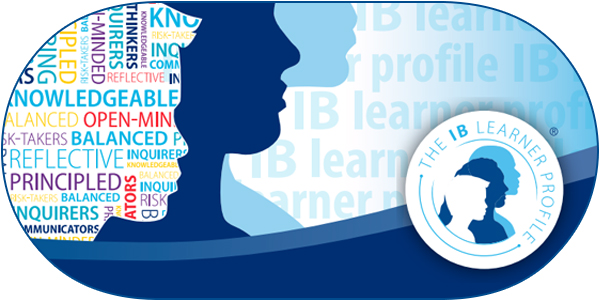
IB World Schools and educators over the years have developed an immense amount of expertise and created learning experiences to support students and guide the teaching and learning with the 10 IB learner profile attributes:

  • knowledgeable
  • thinkers
  • inquirers
  • communicators
  • principled
  • open-minded
  • caring
  • risk-taking
  • balanced
  • reflective

Linking the IB Learner profiles with AI offers educators an opportunity to integrate and use AI tools with an open mind. This open-mindedness doesn’t mean we shouldn’t be cautious, thoughtful, and reflective. Instead, it allows us to adopt potential opportunities while being mindful of the implications.
Exploring the potential of AI, generative AI and large language models with the IB learner profile attributes provides many learning opportunities. The ways in which the IB learner profile attributes of knowledgeable and thinkers can support the responsible and effective adoption of AI are alluded to above. Below I provide a short commentary on how educators can embrace the remaining attributes as they help students navigate the complex world of AI.

Inquirers

As inquirers, educators can explore the complexities of AI, modeling evaluation to highlight the importance of self-directed learning. As educators collaborate in creating activities with colleagues using AI tools, this can help nurture critical thinking and transdisciplinary connections between different subjects.

Communicators

By integrating AI driven scenarios, discussion prompts, real world case studies and role playing exercises, educators can support the growth of their students’ communication skills.

These AI enhanced activities not only grab the students’ attention but also provide them with practical experiences that reflect real life situations, giving them an opportunity to develop a deeper understanding of how to navigate different communications contexts and work in collaborative settings.

By facilitating these approaches, educators mentor their students with important current skills to manage a digitally driven world while creating an environment where learning remains relevant and authentic.

Principled

Educators can facilitate activities to help students understand the significance of integrity, biases and racism through the use of AI tools to delve into matters of ethics, diversity, equity and fairness.

One example would be to analyze text and images from different voices in media outlets to uncover hidden biases. The students use the AI tools to see how hidden biases might be used in the local, national or international media. This activity gives students an opportunity to develop an understanding of the importance of media literacy skills and being critical thinkers of media in their local, national and international context.

Open-minded

With an open-minded approach, educators can build activities that guide students to use AI tools to explore different perspectives and voices. This could involve using AI-generated content to analyze different articles from newspapers and magazines on current events, exposing them to different viewpoints or historical events from different perspectives and cultural lenses. Students are then provided with opportunities to interact with a variety of viewpoints and experiences, enhancing their critical thinking skills.

Caring

As educators, we can model the use of AI tools to emphasize the importance of caring, empathy, compassion, and respect. By leveraging AI tools, activities can be created with simulations and case studies that explore social issues and their impact on local and global communities.

For example, an educator introduces an AI simulation based on real world case studies linked to a social issue connected to the unit or lesson they are focusing on. Through these simulations, supported by teacher generated questions, prompts or activities, students are exposed to the challenges, tensions and complexities of the social issue. This process gives them the experience to read, listen, and watch how individuals and local communities from diverse backgrounds solve this social issue in the lesson.

Risk-taking

Engaging in the learning process, interacting, trying out, and exploring the use of AI tools as educators is an effective way to model risk-taking. Students experiencing this with activities guided by educators will develop confidence when navigating the uncertainties of AI tools.

Balanced

Recognizing the importance of balance and well-being, educators can mentor and help students explore different ways to understand their social, physical, and emotional well-being. This is very important as the use of AI-generated platforms, tools, and experiences become more prominent and are capturing our attention constantly throughout the day.

Reflective

In conclusion, as reflective practitioners, it is essential for school leaders to deliberately carve out the necessary space, allocate time, and provide purposeful professional development to support educators in this journey of AI cohabitation. This ensures that each of us can mentor, model, and guide students of all ages through experiences, activities, and learning pathways. This deliberate integration of AI tools in the learning process is a vital step in cohabiting with AI as equal partners.

John@Beyonddigital.org

Adaptability Quotient (AQ): Navigating “Predictable unpredictability,” 

There is no doubt that a growing, shared realization exists, however challenging it might be at times, that we are transitioning to an era of “Predictable unpredictability,” as quoted in The Economist.  2023 came with a whirlwind of changes, at a pace and magnitude that feels somewhat overwhelming. The sobering truths of climate change have become too frequent a reality for many. The rapid integration and prevalence of artificial intelligence in our lives comes with a mix of fear and excitement. In addition the ongoing geopolitics conflicts we witness have the realities of war on many peoples doorsteps.

Each of these factors affects us uniquely within our respective contexts, each with its distinctive complexities. These accelerated changes are reshaping the realities we have grown accustomed to using as reference points for our own understanding of the world around us. With these changes come new questions and awareness that at times seem daunting. 

Photo John Mikton Bois du Nant Switzeralnd

International Schools in general possess the ability to insulate themselves from a certain degree to the changes surrounding them—I refer to this as a “walled garden.” This process  is purposeful and occurs gradually and cautiously, with the intention of providing a caring and age-appropriate set of learning experiences and pathways. The objective and design are centered around supporting students in navigating the multitude of changes from the world they live in both at home and school in a safe and nurturing environment. International Schools curate these learning journeys, choreographing learning pathways that progressively develop, and create connections aligned with a curriculum and educational principles. This process requires patience, is delicate, intricate, and nuanced. 

We all agree in principle as educators, and believe that the capacity to adapt to different situations and problems is vital for managing and navigating life’s challenges. Understanding this, it’s important for us to reflect on how we react when confronted with such rapid changes, especially when we lack control or have minimal influence over the timing or consequences. The growing necessity to be in a constant flux of adaptability is challenging and at times exhausting. We are in a new narrative where we have to readjust our established understandings. Change disrupts the routines and habits we find comfort in—routines which provide us with stability, continuity, and familiarity. All important for our sense of purpose. 

If “Predictable unpredictability,” creates a break from our routines and becomes the new normal, the capacity to adapt will only be amplified as a critical mindset for International Schools to flourish by. This is where the concept of Adaptability Quotient (AQ)  (also often referred to as adaptability intelligence) – becomes important for International Schools and educators to harness .  

Robert J. Sternberg,  psychology professor at Cornell University, defines adaptive intelligence as  “the intelligence one needs to adapt to current problems and to anticipate future problems of real-world environments.” Educ. Sci. 2021, 11(12), 823; https://doi.org/10.3390/educsci11120823

The mindsets associated with AQ revolve on identifying what is relevant, and being comfortable forgetting past knowledge, adjusting to change in real time and being comfortable challenging habits and beliefs. With this an agility to adapt at short notice, always learning and listening with empathy to the different viewpoints of others. 

When International Schools engage with AQ, a challenge lies in the perception of an underlying culture of resistance to change. Change is often perceived as a threat to current and past methods and habits, destabilizing the status quo and eroding the sense of continuity and comfort. 

Changing how schools work, by adjusting and redesigning a curriculum to be flexible and agile to go along with AQ’s ideas, is a big step and a hurdle as we have limited points of reference to address many of the issues and complexities the world is facing mid and long term. The process of these changes require trust and empathy from all involved . This means schools need to design professional development that embraces “unlearning and relearning” and accepts that many of the things we learned and got used to are not always so helpful, even though they brought  a sense of stability and continuity. 

Engaging with the AQ requires an agility to balance new approaches with current approaches and workload. Ensuring we facilitate an iterative process in all school  strategic planning. Finding time to pause – reflect and to internalize the balance between developing new skills and maintaining current skills. 

When one thinks of the many mission statements, and learning principles highlighted by International Schools – such as flexibility, curiosity, innovator, resilience, and being a risk-taker – the notion of engaging with the Adaptability Quotient (AQ) makes sense. The shift is to embrace the idea of not teaching to the past, and accepting “predictable unpredictability” as our point of reference.

This academic year let us invite ourselves to:

“Become a student of change, it is the only thing that will remain constant.” Anthony J.D Angelo Founder of Collegiate Empowerment  & Author

John@beyonddigital.org

Anthony J.D Angelo Founder of Collegiate Empowerment  & Author 

Works referenced

“The new normal is already here. Get used to it.” The Economist, 18 December 2021, https://www.economist.com/leaders/2021/12/18/the-new-normal-is-already-here-get-used-to-it

Sternberg, Robert J. “Adaptive Intelligence: Its Nature and Implications for Education.” MDPI, https://www.mdpi.com/2227-7102/11/12/823.

Saucier, Tracy. “Adaptability Quotient in Schools: AQ Is the New IQ.” Summerfield Waldorf Schools, 14 April 2022, https://summerfieldwaldorf.org/adaptability-quotient-in-International International Schoolss/. 

“Five Brain Leadership – Dr. Carlos Davidovich MD. EMCC.” Coaching y Neuromanagement, https://www.carlosdavidovich.com/en/five-leaders-eng/.

O’Brien, Brendan. “Leadership and Adaptability Quotient (AQ): Moving from EQ to AQ.” Creative Thinking Institute, https://creativethinkinginstitute.com/blog/leadership-and-adaptability-quotient-aq-moving-from-eq-to-aq/. 

Beyond ChatGPT: Automation in Education

Over the last weeks ChatGPT and Natural Language Models of Artificial Intelligence have created a real buzz for many in the technology industry and general media. For schools the arrival of these have generated important reflections and introspection on the role of AI, Chatbots and Natural Language Models in schools and the classroom. ChatGPT bringing on important moments to think about the role #AI in a classroom- schools. How does this refocus and challenge educators pedagogy, which can often in schools be focused on teaching content -knowledge with assessments designed around tests and exams.

We as educators and schools need to invite ourselves to ask what then is the value added proposition of learning in a classroom and school in the age of #AI #ChatGPT3. How do schools position themselves for a future with #AI. We all need to create the space, time, and support community voices to engage with this creative tension. To find the time and space, and hear these voices, will only allow us to be better prepared for such cohabitation.

I had the privileged to participate in a conversation on this topic facilitated by Camillo Montenegro Beyond ChatGPT: Automation in Education with fellow educators Tim Evans, and James Steinhoff. The recording for reference

Further resources to consider

AI in Education collaborative site with a lot of resources, lesson ideas, guides and information to support educators
https://sites.google.com/ecolint.ch/aiineducation?pli=1

Podcast with 3 International School IT Directors discussing its implications.
https://www.theinternationalschoolspodcast.com/e/88-greg-warren-and-wolfgang-with-dan-and-john-look-at-chatgpt3-in-education/

Leading Technological Change- a collaboration with Adam Morris

Over the years working in different international schools as an IT Director, Director eLearning, Head of Education and Media Technology and Deputy Principal I have had the opportunity to lead, design and collaborate with Leadership Teams and IT Teams the implementation and adoption of digital ecosystems and environments. These experiences have been an important point of reference in my own learning and understanding on the complexities, challenges and opportunities of leading technology change in a international school setting.

I had the privilege to be able to collaborate and co-write this eGuide with Adam Morris who is Schools Technology & Integrations Director @ FariaOne Group. A special thank you goes out to the Managebac team who provided us with support and guidance throughout the process. As the group worked and collaborated together on the eGuide Adam and I had the opportunity to each reference our own professional experiences working, coaching and supporting schools around the world with leading technology change.

The guide is a a point of reference to support conversations, reflections and how to engage with technology change with a whole school approach. It is there to provide provocations, points of reference on change and the workflows and dispositions to consider as one engages in a technology change process with a whole school approach https://guide.fariaedu.com/leading-technology-

change/

Hal, is in the house.

Harvest
Fall Harvest Photo jmikton

A colleague of mine and her Kindergartners were busy exploring where an egg comes from. “Was it born like a baby? Does it grow on its own? Where do they come from? Different perspectives and ideas were shared enthusiastically. The children discussed and challenged each other with their theories. At the end of the activity, one child turned to her partner and said, “when I get home, I’ll ask Siri for the answer.” A routine response in our classrooms? Or an important moment to understand that artificial intelligence (AI)  has embedded itself in our day to day lives? For a generation of children who have been raised on iPads and Siri,  AI – with a name and voice like a human – is as ubiquitous as any other technology.

AI is a tool that learns, anticipates and predicts. It provides us with instantaneous information or completes routine tasks remotely. The Amazon Echo and Google Home, two new devices that have recently gained traction, have begun to enter the home as personal assistants. The Echo and Home are two of many voice-activated AI assistants that tap into vast artificial intelligence networks. They aggregate information based on our digital footprints and predict our habits based on a learning algorithm that engages continuously with the data we share on our digital devices.

A shift has occurred in our relationship with AI and the impact is profound. It is the seamless adaptation of AI into our lives – a frictionless experience that is slowly making us dependent on this predictive technology. This new relationship meets our unique taste and needs, and only gets better the more it knows about us. Over time, this is changing the way our brain functions when interacting in the digital world. This short video by AcademicEarth.org -“ Cognitive Offloading,” is a reminder of the neurological changes AI is having on our learning.  We collectively feel more and more comfortable subcontracting out tasks to AI. The term ” let me google this” is an example.

For educators, this shift is showing up in our classrooms informally and in some instances invisibly.  Artificial intelligences are important elements of the devices which exist in our school tool kits. These include mobile devices, apps, browsers, search engines, smartwatches, and more. Writer and professor Jason Ohler asks an important question in his article “Bio-Hacked Students On the Outer Edge of Digital Citizenship”. How should we, as educators, shift the curation of a scholastic experience when students come to the classroom with embedded or wearable artificial intelligences? This alters the value of the commodity of knowledge in the classroom and highlights a potentially new hierarchy where AI supplements a user’s expertise. Suddenly, we have 24/7 access to predictive and anticipatory information which has the potential to disrupt the independent learning experience of a typical classroom. In his article “Artificial intelligence is the next giant leap in education“, Alex Wood reflects on the role AI could play in education.

 <https://upload.wikimedia.org/wikipedia/commons/thumb/f/f6/HAL9000.svg/2000px-HAL9000.svg.png>
source: <https://upload.wikimedia.org/wikipedia/commons/thumb/f/f6/HAL9000.svg/2000px-HAL9000.svg.png&gt;

Coming to terms with these exponential changes takes time to digest. As educators, we need to understand that engagement and critical thinking are vital components of education, especially as AI shifts the classroom narrative. The ethical issues which surround these exponential changes are here now. The complacency that schools engage with in the discourse of what it means to be in a world dominated by AI is a tension we cannot ignore.

What will a world look like when companies can remotely delete pictures and videos which do not fit a predefined perspective fueled by an AI?  Danny Yadron questions this in his article “Apple gets patent for remotely disabling iPhone cameras.” What will a world look like when you scan a person’s image on the street and instantly receive their aggregated digital profile? In Shawn Walker”s  “Face recognition app taking Russia by storm may bring end to public anonymity  ” he shares the dynamics of the “FindFace” application, reminding us of the reality at our doorstep.

As educators, we have a unique opportunity to design curriculums around the narrative of artificial intelligence. We need to be encouraging our students to not only be good digital citizens but proactive digital leaders who understand the complexity of a world fueled by artificial AI. Schools should promote the skills and inquiry mindsets which provide students with the capacity to harness the power and opportunities of AI and not become complacent with the technology. Ultimately, we want our students to be active leaders and architects of AI’s continued growth. As educators, we have a responsibility to ensure our students have a working understanding of how to navigate a complex and changing world fueled by artificial intelligence for the good of future generations.

John@beyonddigital.org


Living in a “GAFA” world.

Think of what Google, Apple, Facebook and Amazon services and products you use daily. How much are they a vehicle for communications, work, social life, purchases and tasks? How often do you connect to them? Count the number. How many? Surprised? Now, out of the 4 companies, how many do you use? Or do you not. The reality is that you probably use at least one, if not all of the four, very frequently.

Lac Leman, Rolle Switzerland -photo J.Mikton

Welcome to the “GAFA” (Google, Apple, Facebook, Amazon) world. The”GAFA” world is where most of humanity’s internet users and consumers work, communicate, socialize, learn, entertain themselves, and share, in services provided by one, two, three or all four of these companies: the “GAFA” grids.

We have become comfortable with “GAFA’” being part of our lives in multiple venues, and as a result, schools, educators, students and parents are investing significant amounts of monies into “GAFA”. It is an essential component of our ability to function at school and at home, and the collective convenience and seamless experience of “GAFA” intoxicates us.

In Terry Heick’s (@TeachThought) thoughtful article “How Google Impacts The Way Students Think”,  he highlights how learners working in a Google ecosystem develop an appetite for a black and white information age.  The expectation? Immediate answers, 24/7. The convenience of this immediacy creates an illusion of thinking, but actually disengages the user from deep critical thinking. It does this by simplifying the process of gathering information and giving the impression it is all connected.

In order to have a constant infusion of innovation and creativity, “GAFA” also hungers for start-up companies. By absorbing these companies, they are able to facilitate the pollination of ideas, products and services and enrich their ability to generate more seamless methods of connectivity. In this way “GAFA’s” largeness and versatility is engrained in all aspects of our lives

This innovation also provides “GAFA” with opportunities to tie our lives closer together with multiple platforms and venues in a frictionless environment. Examples of this reach are Amazon’s cloud service, which hosts large architectures of company websites, services, and databases, including the CIA’s; Google moving into the home with Nest and pursuing the development of artificial intelligence (Dark Blue Labs and Vision Factory); Apple’s acquisition of Affectiva, a company that specializes in emotion recognition, and investments in health apps and services; and Facebook’s expansion into virtual reality.  Making its services ubiquitous, as with the “free wi-fi-with-check-in ”in hotels and small businesses. Its purchase of “Whatsapp” is another example of how a “GAFA” company spent billions on an innovative service.

The algorithms provide a treasure trove of information with which to understand our behavior, habits, aspirations and desires.  In Raffi Khatchadourian’s  article “We Know How You Feel”, we are reminded that the hunger for data is tied to a hunger for emotional interactions. In Shelley Podolyn’s New York Times article, “If an Algorithm Wrote This, How Would You Even Know?”,  she highlights the level of sophistication of writing algorithms generating news articles and books. In tandem, the growth of “The Internet of Eyes“ in objects we interact with, as part of the “ Internet of Things.” brings about a new dynamic to data mining. It is a reminder that many of these algorithms being designed within “GAFA” play an almost non-negotiable role in our lives.

Many schools believe that their curriculum’s should allow for authentic connections to the world around them. What about “GAFA”?  Should we as learners, guides, mentors, and facilitators highlight “GAFA”? Is this important? Should its presence be considered in our learning outcomes?  To ignore “GAFA” is to create a disconnect with present changes that are reshaping all of our lives. It sidelines a reality that is the future. What does “GAFA” mean, to us, our schools, community and educational institutions? Schools have a responsibility to ensure this is part of the curricular discourse.  We need to construct learning moments and scaffold time to pause, reflect, understand, explain and critically think about what it is to live in a “GAFA” world.

If personal privacy, independent thought, critical thinking, differentiation, balanced perspectives, mindfulness and our capacity to be unique are in our school’s mission, we need to address what it means to be curated by “GAFA”.  Will we not lose an important aspect of humanity, if we continue to ignore “GAFA”?

John@beyonddigital

P.S: Next time you are at a Starbucks drinking your coffee remember that the free wifi is a “GAFA” gift!

There is a needle in the haystack, Ground Control.

All of us are engaged daily in the process of looking for information on the Internet, or “searching“. Sometimes, we search for clarification, facts, confirmation, projects, solutions, while other times our searches help us broaden our views, come to terms with a concept, make a plan, find a definition, or cross check a fact. Watch yourself or a friend at your next social function. Someone is bound to pull out their portable digital device (phone, tablet and/or computer) before long to make sure something that was said is correct. They might look up an actor, a city, an album, a song, a title, or an author. This is now part of our daily digital diet: a quick hop onto our device and off into the Internet to “search” for information.

  • 51 million – Number of websites added during the year.
  • 1.2 trillion Number of searches on Google  in 2012.
  • 43,339,547 gigabytes are sent across all mobile phones globally everyday.
  • Humankind in 2007 successfully sent 1.9 zettabytes of information through broadcast technology such as televisions and GPS. That’s equivalent to every person in the world reading 174 newspapers every day.
  • There are 5 million tweets per day enough to fill New York Times for 19 years.
  • Humankind shared 65 exabytes of information through two-way telecommunications in 2007
    That’s the equivalent of every person in the world communicating the contents of six newspapers every day
  • 58 – Number of photos uploaded every second to Instagram.
  • 5 billion – How many times per day the +1 button on Google+ is used
  • 1.3 exabytes – Estimated global mobile data traffic per month in 2012.
  • Bloggers post 900,000 new articles everyday.
  • Over 210 billion emails are sent daily which is more than a whole year worth of letter mail in the USA.
  • Daily around 200 000 videos are uploaded on youtube which will require over 600 years to view them all.

(Source: Economist  The World 2013 and Internet 2012 in numbers by Tech Blog Pingdom and Science Daily: How Much Information Is There in the World? Feb. 11, 2011)

Information grows from Terabyte to Petabyte . As a human race, we cannot actually view, analyze, or keep track of all the information we generate without third party digital tools and softwares. We now defer to sophisticated algorithms and intelligent softwares to store, track, synthesis, analysis, aggregate, and deliver information in amounts we have the time and capacity to digest. And most of us today expect to have this information available non-stop, over multiple devices.

Information overload, information stress, information pollution and information anxiety are part of the narrative of the digital age. With the amount of information increasing at accelerated speeds, we have relinquished any control we once had over its exponential growth. What we need to do is develop strategies, skills and understanding on how to filter, sift, analyze and juggle information, so we feel some level of control.

As we embed ourselves in this vast information landscape and wish to remain critical thinkers, we need to be ready to retool ourselves:

  • Coming to terms with the “Filter Bubble : this is where information is processed and delivered through algorithms based on what our viewing and search habits are, thus filtering information to our perspectives and not providing alternative views and information. The balance of information is vital to building a broad understanding of different views. Nowadays however, through the “Filter Bubble, this balance is being diluted. We need to understand this and be able to counter it as critical thinkers.
  • Developing a strong searching expertise:  We need to understand the capacity of search engine tools, their variables, and limitations so we can refine and sift information in a manner which gives us manageable amounts of results.
  • Be able to Aggregate:  Learn how to leverage news aggregators, real time syndication, social media, micro blogging, and social bookmarking sites.  These tools can help in sorting different formats, cull large amounts of information and deliver it in digestible portions for us to develop new capacities.
  • Engage in Connectivism: A learning theory constructed on the idea we can learn with digital, social and cultural connections, and from this interchange build individual and/or collective capacity to gain knowledge and understanding. Through our social and professional connections create networks of expertise, knowledge, and understanding to support learning. Use the “cognitive surplus” we have available in our social and professional groups to increase our own knowledge so we can create, communicate, produce and share effectively as critical thinkers.
  • Learn, unlearn and relearn: We need to develop the strategies and methodologies that allow us to engage effectively in this process of “learning, unlearning and relearning” daily. In tandem, we need to ensure that everyone has the opportunity, support and resources to do this.

From this point forward, there is not going to be any less information – that is a fact. As the world moves into a state of constant change, and the pace accelerates, we have a responsibility to ourselves, our peers and our communities to make the process of learning, unlearning and relearning permanent. If we do not, we could potentially lose our ability to participate as critical thinkers and control the information landscape we live in.

John@ http://beyonddigital.org