Living in a “GAFA” world.

Think of what Google, Apple, Facebook and Amazon services and products you use daily. How much are they a vehicle for communications, work, social life, purchases and tasks? How often do you connect to them? Count the number. How many? Surprised? Now, out of the 4 companies, how many do you use? Or do you not. The reality is that you probably use at least one, if not all of the four, very frequently.

Lac Leman, Rolle Switzerland -photo J.Mikton

Welcome to the “GAFA” (Google, Apple, Facebook, Amazon) world. The”GAFA” world is where most of humanity’s internet users and consumers work, communicate, socialize, learn, entertain themselves, and share, in services provided by one, two, three or all four of these companies: the “GAFA” grids.

We have become comfortable with “GAFA’” being part of our lives in multiple venues, and as a result, schools, educators, students and parents are investing significant amounts of monies into “GAFA”. It is an essential component of our ability to function at school and at home, and the collective convenience and seamless experience of “GAFA” intoxicates us.

In Terry Heick’s (@TeachThought) thoughtful article “How Google Impacts The Way Students Think”,  he highlights how learners working in a Google ecosystem develop an appetite for a black and white information age.  The expectation? Immediate answers, 24/7. The convenience of this immediacy creates an illusion of thinking, but actually disengages the user from deep critical thinking. It does this by simplifying the process of gathering information and giving the impression it is all connected.

In order to have a constant infusion of innovation and creativity, “GAFA” also hungers for start-up companies. By absorbing these companies, they are able to facilitate the pollination of ideas, products and services and enrich their ability to generate more seamless methods of connectivity. In this way “GAFA’s” largeness and versatility is engrained in all aspects of our lives

This innovation also provides “GAFA” with opportunities to tie our lives closer together with multiple platforms and venues in a frictionless environment. Examples of this reach are Amazon’s cloud service, which hosts large architectures of company websites, services, and databases, including the CIA’s; Google moving into the home with Nest and pursuing the development of artificial intelligence (Dark Blue Labs and Vision Factory); Apple’s acquisition of Affectiva, a company that specializes in emotion recognition, and investments in health apps and services; and Facebook’s expansion into virtual reality.  Making its services ubiquitous, as with the “free wi-fi-with-check-in ”in hotels and small businesses. Its purchase of “Whatsapp” is another example of how a “GAFA” company spent billions on an innovative service.

The algorithms provide a treasure trove of information with which to understand our behavior, habits, aspirations and desires.  In Raffi Khatchadourian’s  article “We Know How You Feel”, we are reminded that the hunger for data is tied to a hunger for emotional interactions. In Shelley Podolyn’s New York Times article, “If an Algorithm Wrote This, How Would You Even Know?”,  she highlights the level of sophistication of writing algorithms generating news articles and books. In tandem, the growth of “The Internet of Eyes“ in objects we interact with, as part of the “ Internet of Things.” brings about a new dynamic to data mining. It is a reminder that many of these algorithms being designed within “GAFA” play an almost non-negotiable role in our lives.

Many schools believe that their curriculum’s should allow for authentic connections to the world around them. What about “GAFA”?  Should we as learners, guides, mentors, and facilitators highlight “GAFA”? Is this important? Should its presence be considered in our learning outcomes?  To ignore “GAFA” is to create a disconnect with present changes that are reshaping all of our lives. It sidelines a reality that is the future. What does “GAFA” mean, to us, our schools, community and educational institutions? Schools have a responsibility to ensure this is part of the curricular discourse.  We need to construct learning moments and scaffold time to pause, reflect, understand, explain and critically think about what it is to live in a “GAFA” world.

If personal privacy, independent thought, critical thinking, differentiation, balanced perspectives, mindfulness and our capacity to be unique are in our school’s mission, we need to address what it means to be curated by “GAFA”.  Will we not lose an important aspect of humanity, if we continue to ignore “GAFA”?

John@beyonddigital

P.S: Next time you are at a Starbucks drinking your coffee remember that the free wifi is a “GAFA” gift!

Disrupt Me!

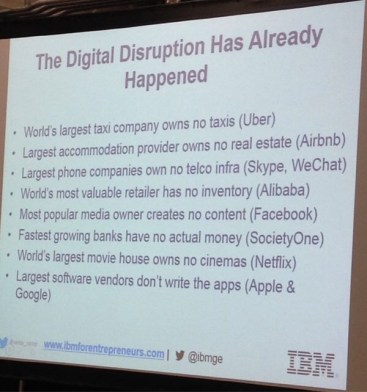
 Disruption has already happend IBM:
Disruption has already happend IBM: Source: IBM http://www.ibmforentrepreneurs.com

Disruption for many people generates discomfort, shakes the status quo and breaks routines. We all have an emotional response to this process: for some hesitation, doubt, confusion, fear, anger, bewilderment, and for others excitement, rejuvenation, inspiration, motivation and energizing or a combination of the above.

The Digital Disruption Has Already Happened”  image on twitter challenged my own thinking, and as I unpacked this with a group of students we all had to take time to unravel what this meant to us. After a healthy discussion we came to a common understanding that each of these companies generated a  “disruption” armed with ideas and models that completely reshape the economic contract of the business world. The disruption challenged a set of expectations, routines and structures, thus redefining what it means to provide a particular service. In the process,  the relationship between worker, employer, customer and their social contracts was also redefined. As these models of disruption become part of our economic ecosystem, a whole new paradigm faces us. A good example of this process is featured in this article “The Last Kodak Moment?” (Economist)

As the students and I further discussed what this means to us here in the classroom, we started realizing a distinct disconnect between the objectives and outcomes of our learning in school and the reality that this image represents. There are two worlds working in very different realms with no clear bridge creating a meaningful authentic connection between them. As one student shared after seeing this video in class, “mmm I find it odd that we are not learning how to make these things in school, or understand how they work or maybe fix them.”

Yes, the world around us is changing rapidly, very rapidly, we know this, we are aware of this, we state this, and are impacted by this daily.  However, our role is often that of the passive consumer, unconsciously sucked in by the addictive seamless convenience of the services these disruptions deliver. In our passivity and growing dependence we seem willing to sideline a more critical reflection of what this disruption is doing to us. The engines of this disruption: creativity, machine learning, algorithms, and innovation are driving the ecosystems which are quickly becoming non negotiables with our work and social flows. These disruptions are inevitable and not bad or good, they are part of today’s economic narrative that impacts us all locally and globally.

But in the bubble of “school” there is a sense that it is okay not to engage with this concretely, giving ourselves permission to continue focusing on learning objectives and outcomes tied to a past. As Michael Wesch shares in this TedTalk: From Knowledgeable to Knowledge-Able,  what we teach, what we engage as “musts” as part of the learning contract are disconnected from the pressing realities surrounding us. This lack of authentic connection and scaffolding which should provide the skills and cognitive capacity to critically engage with the rapidly changing world are watered down to suit our own educational comfort zone and established routines, which have worked so well for us in the past.

Schools are keen to talk about teaching to students’ future and as George Couros share in his book ” Innovators Mindset”, its all our future and all of us need to understand and engage with it concretely, not just the kids. Education rhetoric is rich with 21 century skills terminology and on the surface we are okay to dabble with some ideas and changes, but not at the level where we truly have taken on a deep understanding as educators about what this disruption is doing to our world and how we can act as concierges of learning. We need to ensure our students are not simply consumers of the disruption but empowered creators and active participants of the disruption.

A disruption needs to occur in schools with professional development. In a video by Frank Barrett in the Harvard Business Review “To Innovate, Disrupt Your Routine” he highlights the importance of leaders ability to engage in a process where routines are disrupted to generate opportunities for creativity. As an example he uses the wonderful analogy of Miles Davis’s Kind of Blue album and the disruption he facilitated, disrupting routines which had the group enter a discomfort and then supporting them to create something new that changed the face of Jazz.

It is often the case, and I am generalizing here, that professional development in schools is focused on pedagogy framed by comfort zones that generate no disruption, learning framed with limited clear connections to the real world, lecture style delivery, and bulleted PowerPoints squeezed at the end of a long day of work. This dynamic can generate a level of disconnect, cynicism and passivity by participants, and dilutes the connection between what we teach and how we tie learning to be authentic and connected to the pressing realities surrounding us.

School leaders need to first disrupt their own professional development. They also need to be bold and challenge their own comfort zones. Through this act, we then experience first hand the process described by Frank Barrett in the Harvard Business Review, and will be willing to mentor leadership teams and faculty to go through a similar process with explicit support and care. If we are going to lead and disrupt our routines to engage in a process where we innovate and create then educators need time, space, support, empathy, and meaningful scaffolding. With this we build the capacity to disrupt their own thinking and internalize how they can take ownership with the process. We need to disrupt professional development learning outcomes, so as to be able to craft a learning narrative connected to a world driven by a new economic reality; one framed by creativity, algorithms, machine learning and innovation. Through this process we can then facilitate a culture where educators become active participants of the pressing realities surrounding us and lead and mentor learning with authentic and meaningful connections to the world of disruptions we are living in.

We cannot expect to authentically connect our students’ learning environments with the rich tapestry of the world of economic disruptions without giving ourselves permission to disrupt ourselves first and shift our professional learning discourse to unpack, synthesis, connect and craft learning outcomes that explicitly provide meaningful opportunities for us to make sense of constant disruptive change, and from there as concierges of learning, choreograph an authentic learning landscape for students. “Disrupt me!”

John@beyonddigital.org


Stop Pretending in Education

In education, we have to stop pretending that

  • there is a separation between the digital world and the real world
  • all students have an excellent understanding of digital tools and ethics
  • technology is a learning outcome and not a tool
  • failure and open ended outcomes are bad
  • we are not in a state of constant accelerated change

Scott McLeod challenged others to participate in a conversation on how to #makeschooldifferent with the prompt “… we have to stop pretending”. In this challenge, I’d like to invite @pgreensoup  @jasonohler @arniebieber  @russiazurfluh

The Death of ” Digital”.

Santa Cruz California

Words are a powerful vehicle for meaning and understanding,  connected to individual or group perspectives, interpretations,  and connections. The word “Digital” has been part of our vocabulary landscape for a long time.  It was only after reading Nicholas Negroponte’s  book, “Being Digital” in 1995, that I began to be aware of the term and its impact on the world to come, but in 2014, the word “digital”  has now blended itself into the daily fabric of our lives. When we think of the word “digital”, it creates a sense of disconnect from our world and implies that the digital world is a separate part of our reality. However, this is no longer true. Our lives are so embedded within this digital realm that the two have become inseparable. So, I invite us to use a new set of vocabularies to frame this paradigm:  Appliances, Utilities, Information Flows, Ethics and Algorithms.

Appliances are the consumables that we connect and interact with (laptops, phones, tablets, GPS, and other hardware). These tools have become the default to our connectedness; disposable and with each new version more seamless, simple and integrated.

Utilities frame our day to day interactions. These social medias, networks, email, RSS, professional learning networks and Web 2.0/ 3.0 tools have become the architectural  framework of communication and information for our connected world.

Information flows are the 150,000,000 Blogs posted a year, 5 million tweets per day, 200,000 videos uploaded on YouTube daily, and the petabytes of information created, aggregated, shared, and circulated daily around the earth.

Ethics is the why, how, when, where and who of our digital footprint in today’s world. It is the wide ranging issues from Killer Robots to the impact of a Filter Bubble (where search, news, and information algorithms choreograph what information types we get based on our personal browsing habits). The curation of our online and offline privacy as governments, corporations, and organizations juggle a treasure trove of information created by our respective digital footprints, is the new ethical dilemma we all deal with, as individuals, groups and as societies at large.

Algorithms are the backbone to the intelligent softwares that inhabit the engine of the internet. These are predictive, anticipatory, intelligent and analytical. The are the lifeblood of the internet ecosystems for individuals, governments, corporations, and organizations which then create, develop, build, facilitate, monitor, analyze, synthesize and evaluate our day to day interactions. The algorithms have become the life line to the information flows, ethics, utilities and appliances.

These words are not the definitive list, but reflect a vocabulary we use both from our past and present. They highlight how the “digital” world is ingrained in our daily lives, to the point we often are not even conscious of its presence. This connectedness fueled by our devices and ecosystems now are part of the fabric of our lives, often out of our control, and a non negotiable aspect of our own participation with the day.

A critical understanding of these words and their respective dynamics should be an essential ingredient in School and Organizational curricula. We can no longer think of them as separate entities. We have inherited this reality which now has us connected in ways where opting out becomes the abnormality . These Appliances, Utilities, Information Flows, Ethics and Algorithms are part of the fabric of our world and impact us as humans both consciously and unconsciously.

This discourse needs be given equal time in all educational settings; imbedded as seamlessly in the curriculum as they are in our lives. A responsibility to highlight the power, richness and cautions that come with tying ourselves to a set of appliances, utilities, information flows, ethics and algorithms that have and will continue to change the fabric of our interactions as humans and organizations.

So how do we do this? The key is that these terms and their meanings are introduced as part of the learning landscape in all units of study. Creating authentic connections between these words and the learning environment will then scaffold a clearer understanding of their real world applications. In our school ecosystems most subjects and curricular areas are using technology, often as a separate tool, or as a side show, but, if it is so seamless and embedded in our day to day lives, then we need to translate this into our learning. One of the first steps is to give ourselves permission to change the way we work with this vocabulary. As we change the vocabulary, and with it the meaning and role of these words, we are engaging in an active learning process connected to the changing world.

To ignore this vocabulary is to short change future generations of their awareness of a world that has become more invisible, seamless and blended both in our conscious and unconscious day.  The death of “digital” is here.

John @beyonddigital.org


“Welcome to the Machine”

picture by John Mikton
one of the many wonderful buildings from my visit to New York City

Yes, there is the Internet of Things: a world in parallel to ours were our devices, data, algorithms, gadgets, smart phones and digital tools interconnect, communicate, and work independently of our own input or monitoring. They provide us with efficiencies, automation, services and information, and even do things for us we often do not have time for. Some are invisible to our day to day interactions, while others are an integral part of our toolkit  of our communication and of our work. The convenience, cost savings and growing reliability of the Internet of Things has become a necessary part of our daily work-flow.

This growth is somewhat unbelievable if you take the time to visualize it. We now live in a world where the amount of devices is three times the global population; a growth which shows no signs of stopping

So what does this mean for us? What does it mean to live in a world where our dependence on digital devices and hardware ecosystems is non negotiable? As our lives get tied up in a world of machines, how do we balance, control, monitor and engage with the Internet of Things in a manner which allows us to still feel in control?

The digital devices we use, connect and interact with have become seamless parts of our day. Many of the processes and tasks that they complete are invisible to us. Rarely do we need to take our digital devices and tools apart, or sit down and understand how they work or why they are working, and this growing disconnect between our own understanding and participation with the Internet of Things is creating a gap. A gap where we are becoming more and more sidelined; where we are no longer active but passive consumers of the Internet of Things.

The Internet of Things is predictive and intelligent. This dynamic will impact our world significantly: redefining organizations, work forces, how we function as economies and societies. In tandem, it will challenge our ethics, relationship and interactions with machines.

For educators and educational institutions, this reality should be putting pressure on how we engage and deliver learning models so we may remain relevant in a world of machines. There is no doubt that continuing with our current models still seems acceptable, but are we avoiding the present with a belief and a pedagogy rooted in our past? How much longer can we allow this disconnect to occur in the walled gardens of our educational organizations?

The fact is, the world of today, and more importantly, the world of tomorrow, needs us to re-evaluate and redefine our pedagogy. We have a responsibility to ensure that every learner is immersed in a curriculum deeply rooted in authentic, relevant, connected, personalized, differentiated and collaborative learning ecosystems. The Internet of Things and our world require all of us to be critical thinkers and problem solvers. The worlds accelerated rate of change will not wait for our hesitations and indecisiveness to radically redefine our pedagogy. To feel comfortable and continue with a system that is outdated is a terrible way to model and mentor our learners.

The future actually happened yesterday, so let us engage and be proactive in taking the dive to reshape and redesign our educational organizations to bridge the growing disconnect with the Internet of Things. It is the present and our student’s future which we need to act on.

John@ http://beyonddigital.org

There is a needle in the haystack, Ground Control.

All of us are engaged daily in the process of looking for information on the Internet, or “searching“. Sometimes, we search for clarification, facts, confirmation, projects, solutions, while other times our searches help us broaden our views, come to terms with a concept, make a plan, find a definition, or cross check a fact. Watch yourself or a friend at your next social function. Someone is bound to pull out their portable digital device (phone, tablet and/or computer) before long to make sure something that was said is correct. They might look up an actor, a city, an album, a song, a title, or an author. This is now part of our daily digital diet: a quick hop onto our device and off into the Internet to “search” for information.

  • 51 million – Number of websites added during the year.
  • 1.2 trillion Number of searches on Google  in 2012.
  • 43,339,547 gigabytes are sent across all mobile phones globally everyday.
  • Humankind in 2007 successfully sent 1.9 zettabytes of information through broadcast technology such as televisions and GPS. That’s equivalent to every person in the world reading 174 newspapers every day.
  • There are 5 million tweets per day enough to fill New York Times for 19 years.
  • Humankind shared 65 exabytes of information through two-way telecommunications in 2007
    That’s the equivalent of every person in the world communicating the contents of six newspapers every day
  • 58 – Number of photos uploaded every second to Instagram.
  • 5 billion – How many times per day the +1 button on Google+ is used
  • 1.3 exabytes – Estimated global mobile data traffic per month in 2012.
  • Bloggers post 900,000 new articles everyday.
  • Over 210 billion emails are sent daily which is more than a whole year worth of letter mail in the USA.
  • Daily around 200 000 videos are uploaded on youtube which will require over 600 years to view them all.

(Source: Economist  The World 2013 and Internet 2012 in numbers by Tech Blog Pingdom and Science Daily: How Much Information Is There in the World? Feb. 11, 2011)

Information grows from Terabyte to Petabyte . As a human race, we cannot actually view, analyze, or keep track of all the information we generate without third party digital tools and softwares. We now defer to sophisticated algorithms and intelligent softwares to store, track, synthesis, analysis, aggregate, and deliver information in amounts we have the time and capacity to digest. And most of us today expect to have this information available non-stop, over multiple devices.

Information overload, information stress, information pollution and information anxiety are part of the narrative of the digital age. With the amount of information increasing at accelerated speeds, we have relinquished any control we once had over its exponential growth. What we need to do is develop strategies, skills and understanding on how to filter, sift, analyze and juggle information, so we feel some level of control.

As we embed ourselves in this vast information landscape and wish to remain critical thinkers, we need to be ready to retool ourselves:

  • Coming to terms with the “Filter Bubble : this is where information is processed and delivered through algorithms based on what our viewing and search habits are, thus filtering information to our perspectives and not providing alternative views and information. The balance of information is vital to building a broad understanding of different views. Nowadays however, through the “Filter Bubble, this balance is being diluted. We need to understand this and be able to counter it as critical thinkers.
  • Developing a strong searching expertise:  We need to understand the capacity of search engine tools, their variables, and limitations so we can refine and sift information in a manner which gives us manageable amounts of results.
  • Be able to Aggregate:  Learn how to leverage news aggregators, real time syndication, social media, micro blogging, and social bookmarking sites.  These tools can help in sorting different formats, cull large amounts of information and deliver it in digestible portions for us to develop new capacities.
  • Engage in Connectivism: A learning theory constructed on the idea we can learn with digital, social and cultural connections, and from this interchange build individual and/or collective capacity to gain knowledge and understanding. Through our social and professional connections create networks of expertise, knowledge, and understanding to support learning. Use the “cognitive surplus” we have available in our social and professional groups to increase our own knowledge so we can create, communicate, produce and share effectively as critical thinkers.
  • Learn, unlearn and relearn: We need to develop the strategies and methodologies that allow us to engage effectively in this process of “learning, unlearning and relearning” daily. In tandem, we need to ensure that everyone has the opportunity, support and resources to do this.

From this point forward, there is not going to be any less information – that is a fact. As the world moves into a state of constant change, and the pace accelerates, we have a responsibility to ourselves, our peers and our communities to make the process of learning, unlearning and relearning permanent. If we do not, we could potentially lose our ability to participate as critical thinkers and control the information landscape we live in.

John@ http://beyonddigital.org