
I had the pleasure of joining The International Schools Network event What is True: The Essential Role of Media Literacy in Schools. It was an honour to be part of a thoughtful panel discussion exploring how schools can navigate the growing challenges of misinformation, disinformation, and deep fakes in our daily digital lives. I was invited to open the session with a short keynote, sharing some of the key tensions we face as educators in helping students make sense of an increasingly complex media landscape.
Category: International School IT
Exploring AI’s Impact on Education: Opportunities and Ethical Dilemmas
Periodically, I have the privilege of facilitating conversations with the #ISLECISLoft, hosted by Nancy Lhoest-Squicciarini. A topic at the forefront of discussions with educators and school leaders is the growing prominence of artificial intelligence (AI) tools and their impact on reshaping learning. The opportunities and challenges of this technology are complex and nuanced.
AI brings many questions to the table, particularly as we explore the value-added proposition of schools when such powerful tools are accessible 24/7 at home and in classrooms. Within this context, the issues of bias, racism, and the ethical dilemmas these tools raise challenge our beliefs and values.
A real pleasure to have this conversation with Ken Shelton and Dee Lanier, authors of The Promises and Perils of AI in Education: Ethics and Equity Have Entered The Chat . Enjoy !
Adaptability Quotient (AQ): Navigating “Predictable unpredictability,”
There is no doubt that a growing, shared realization exists, however challenging it might be at times, that we are transitioning to an era of “Predictable unpredictability,” as quoted in The Economist. 2023 came with a whirlwind of changes, at a pace and magnitude that feels somewhat overwhelming. The sobering truths of climate change have become too frequent a reality for many. The rapid integration and prevalence of artificial intelligence in our lives comes with a mix of fear and excitement. In addition the ongoing geopolitics conflicts we witness have the realities of war on many peoples doorsteps.
Each of these factors affects us uniquely within our respective contexts, each with its distinctive complexities. These accelerated changes are reshaping the realities we have grown accustomed to using as reference points for our own understanding of the world around us. With these changes come new questions and awareness that at times seem daunting.

International Schools in general possess the ability to insulate themselves from a certain degree to the changes surrounding them—I refer to this as a “walled garden.” This process is purposeful and occurs gradually and cautiously, with the intention of providing a caring and age-appropriate set of learning experiences and pathways. The objective and design are centered around supporting students in navigating the multitude of changes from the world they live in both at home and school in a safe and nurturing environment. International Schools curate these learning journeys, choreographing learning pathways that progressively develop, and create connections aligned with a curriculum and educational principles. This process requires patience, is delicate, intricate, and nuanced.
We all agree in principle as educators, and believe that the capacity to adapt to different situations and problems is vital for managing and navigating life’s challenges. Understanding this, it’s important for us to reflect on how we react when confronted with such rapid changes, especially when we lack control or have minimal influence over the timing or consequences. The growing necessity to be in a constant flux of adaptability is challenging and at times exhausting. We are in a new narrative where we have to readjust our established understandings. Change disrupts the routines and habits we find comfort in—routines which provide us with stability, continuity, and familiarity. All important for our sense of purpose.
If “Predictable unpredictability,” creates a break from our routines and becomes the new normal, the capacity to adapt will only be amplified as a critical mindset for International Schools to flourish by. This is where the concept of Adaptability Quotient (AQ) (also often referred to as adaptability intelligence) – becomes important for International Schools and educators to harness .
Robert J. Sternberg, psychology professor at Cornell University, defines adaptive intelligence as “the intelligence one needs to adapt to current problems and to anticipate future problems of real-world environments.” Educ. Sci. 2021, 11(12), 823; https://doi.org/10.3390/educsci11120823
The mindsets associated with AQ revolve on identifying what is relevant, and being comfortable forgetting past knowledge, adjusting to change in real time and being comfortable challenging habits and beliefs. With this an agility to adapt at short notice, always learning and listening with empathy to the different viewpoints of others.
When International Schools engage with AQ, a challenge lies in the perception of an underlying culture of resistance to change. Change is often perceived as a threat to current and past methods and habits, destabilizing the status quo and eroding the sense of continuity and comfort.
Changing how schools work, by adjusting and redesigning a curriculum to be flexible and agile to go along with AQ’s ideas, is a big step and a hurdle as we have limited points of reference to address many of the issues and complexities the world is facing mid and long term. The process of these changes require trust and empathy from all involved . This means schools need to design professional development that embraces “unlearning and relearning” and accepts that many of the things we learned and got used to are not always so helpful, even though they brought a sense of stability and continuity.
Engaging with the AQ requires an agility to balance new approaches with current approaches and workload. Ensuring we facilitate an iterative process in all school strategic planning. Finding time to pause – reflect and to internalize the balance between developing new skills and maintaining current skills.
When one thinks of the many mission statements, and learning principles highlighted by International Schools – such as flexibility, curiosity, innovator, resilience, and being a risk-taker – the notion of engaging with the Adaptability Quotient (AQ) makes sense. The shift is to embrace the idea of not teaching to the past, and accepting “predictable unpredictability” as our point of reference.
This academic year let us invite ourselves to:
“Become a student of change, it is the only thing that will remain constant.” Anthony J.D Angelo Founder of Collegiate Empowerment & Author
Anthony J.D Angelo Founder of Collegiate Empowerment & Author
Works referenced
“The new normal is already here. Get used to it.” The Economist, 18 December 2021, https://www.economist.com/leaders/2021/12/18/the-new-normal-is-already-here-get-used-to-it
Sternberg, Robert J. “Adaptive Intelligence: Its Nature and Implications for Education.” MDPI, https://www.mdpi.com/2227-7102/11/12/823.
Saucier, Tracy. “Adaptability Quotient in Schools: AQ Is the New IQ.” Summerfield Waldorf Schools, 14 April 2022, https://summerfieldwaldorf.org/adaptability-quotient-in-International International Schoolss/.
“Five Brain Leadership – Dr. Carlos Davidovich MD. EMCC.” Coaching y Neuromanagement, https://www.carlosdavidovich.com/en/five-leaders-eng/.
O’Brien, Brendan. “Leadership and Adaptability Quotient (AQ): Moving from EQ to AQ.” Creative Thinking Institute, https://creativethinkinginstitute.com/blog/leadership-and-adaptability-quotient-aq-moving-from-eq-to-aq/.
Adaptability Quotient (AQ)
Reflecting on the Adaptability Quotient (AQ): To stay pertinent amidst today’s “predictable unpredictability,” I recognize that as an educator, I must present learners with genuine chances to grasp and use concepts across various disciplines, mediums, and settings. I’ve learned that nurturing adaptability, fostering critical thinking, and encouraging problem-solving skills are essential. It’s not always about finding clear solutions but often about engaging with fragmented opportunities within a backdrop of consistent unpredictability. This journey has highlighted the importance of an adaptability-focused mindset, and here, I delve into some of these key ideas and methods.
Thank you to Carlos Davidovich for his mentorship and many conversation exploring together this in a school context
Cybersecurity for International Schools
Cybersecurity is a multifaceted and complex issue, particularly in today’s world where a significant portion of our time, information, and lives are tied to digital devices, both for personal and professional purposes. It is increasingly crucial to possess a basic understanding and knowledge of securing one’s devices and managing digital security. For schools, the stakes are particularly high, and developing a solid cybersecurity plan is a critical aspect of managing the risks associated with digital devices in this day and age.
Recently, Dan Taylor, the host of the #internationalschoolpodcast, and I, the co-host, had an opportunity to discuss cybersecurity in schools, with a particular emphasis on international schools. Both of us have a keen interest in this subject, and Dan has been actively supporting international schools with Google Education Workspace’s robust security tools and processes. He has a genuine passion for this topic and has been doing a lot of work in this area. Meanwhile, I have facilitated workshops for parents, created videos and educator sessions, and worked with groups that provide one-on-one support and workshops to seniors focused on navigating digital ecosystems and devices.
In our discussion, Dan prepared an excellent slide presentation for the ECIS Leadership Conference, which he used to facilitate workshops for school leaders. We took the opportunity to share our perspectives and experiences, offering tips and strategies for school leaders to consider. Podcast version also available here
Leading Technological Change- a collaboration with Adam Morris
Over the years working in different international schools as an IT Director, Director eLearning, Head of Education and Media Technology and Deputy Principal I have had the opportunity to lead, design and collaborate with Leadership Teams and IT Teams the implementation and adoption of digital ecosystems and environments. These experiences have been an important point of reference in my own learning and understanding on the complexities, challenges and opportunities of leading technology change in a international school setting.
I had the privilege to be able to collaborate and co-write this eGuide with Adam Morris who is Schools Technology & Integrations Director @ FariaOne Group. A special thank you goes out to the Managebac team who provided us with support and guidance throughout the process. As the group worked and collaborated together on the eGuide Adam and I had the opportunity to each reference our own professional experiences working, coaching and supporting schools around the world with leading technology change.
The guide is a a point of reference to support conversations, reflections and how to engage with technology change with a whole school approach. It is there to provide provocations, points of reference on change and the workflows and dispositions to consider as one engages in a technology change process with a whole school approach https://guide.fariaedu.com/leading-technology-
“Behavior Surplus” reflecting on digital balance.
I had the privilege to share some of my own reflections on digital devices, “behavior surplus” and balancing digital consumption with @DelanoMagazine podcast Newsmakers: podcast: spoti.fi/3Dq8IzP and article

Digital Citizenship to Digital Fluency

Over the last 18 months, our time spent online has simply increased to levels maybe not experienced prior to the pandemic. As we continue to juggle the complexity and nuisance of the pandemic, this also maybe is an opportunity for schools to re-explore their relationship to digital citizenship. The growing erosion of our privacy as well as our amplified cohabitation with Artificial Intelligence (AI) present us with new challenges.
We all have become so much more aware of being tracked 24/7 with digital ecosystem grids which are seamless and frictionless parts of our daily routines. In (The Age of Surveillance Capitalism), Shoshana Zuboff describes this process of tracking “behavior surplus. Behavior surplus is the personal data that we leave on our devices and give away daily based on a mutual agreement (user agreements) between the digital companies and us. These agreements (when is the last time you read a user agreement?) give permission for our behaviors online/offline to be tracked, collected, monitored and analyzed by companies and in some cases governments at will. The purpose of “surveillance capitalism” is to leverage this “behavior surplus” to mitigate the uncertainty of our desires and to better predict what we will do. This is then turned into a profitable commodity. The value of our “behavior surplus” is unprecedented and the raw material of human data is fueling the engines of innovation, economics, politics and power.
Over the past few years, and in some ways accelerated even more in the last 18 months, AI has a growing impact on our lives, more often than we realize. Daily, it seems we develop a growing dependency on this cohabitation with AI: be it our GPS, HomeAssistant, iRobot vacuum cleaner, Health Device, Dating Apps, SmartWatch, or SmartTV. For our students, this seamless integration of AI into our lives often comes as a frictionless change. Tik Tok is a great example of this – a social media platform with sophisticated AI and unprecedented tracking algorithms, which in a short time added 1 billion users. Overnight, Tik Tok become a teen favorite and serious competition to Snapchat and Instagram. For many educators, new digital consumables are embraced with hesitancy but somehow often the convenience is enticing enough for us to succumb to the charm of the “smart” and “wifi“ ready products.
I have worked with groups of educators and students to build a series of lessons around ARTE’s Do Not Track in order to highlight the complexity and intricacies of how we are tracked. The different episodes are thoughtfully constructed with interactive components breaking down the erosion of privacy. I am surprised how often a percentage of students confidently express their indifference with this erosion of privacy and its implications. In some ways this makes sense. If the current privacy landscape is the sole point of reference, the current state of privacy is interpreted as normal. In comparison, educators interacting with ARTE’s Do Not Track respond with far more anxious discomfort as for many this erosion is compared to experiences where individuals felt greater control over their privacy. As we re-explore digital citizenship, we need to take these varying perspectives into consideration.
The fact is that most of our students are highly proficient digital consumers and not digital natives. The same goes for many educators in general. If we think of our own interactions with digital environments, it’s very likely that most of our time is focused on consumption over creation.
We need to consider re-framing how we support educators and students in a school setting away from a sole focus on digital citizenship to a broader focus on digital fluency. This requires us to develop an approach where the focus is on developing purposeful connections to our digital ecosystems with the goal of becoming ethical digital creators of content.
The concept and idea behind digital fluency is built on the work of the DQ Institute and its DQ Framework and the 8 digital intelligences. Digital fluency is facilitating an approach where learning opportunities are constructed around the natural connections of our day to day lives with these 8 digital intelligences. The important aspect of this focus is not excluding other essential learning in the curriculum. To make this meaningful, digital fluency needs to have clear connection points to personal experience, ensure these connection points are purposeful, and build on the learning already taking place in a school’s curriculum and the different learning pathways of the units of learning.
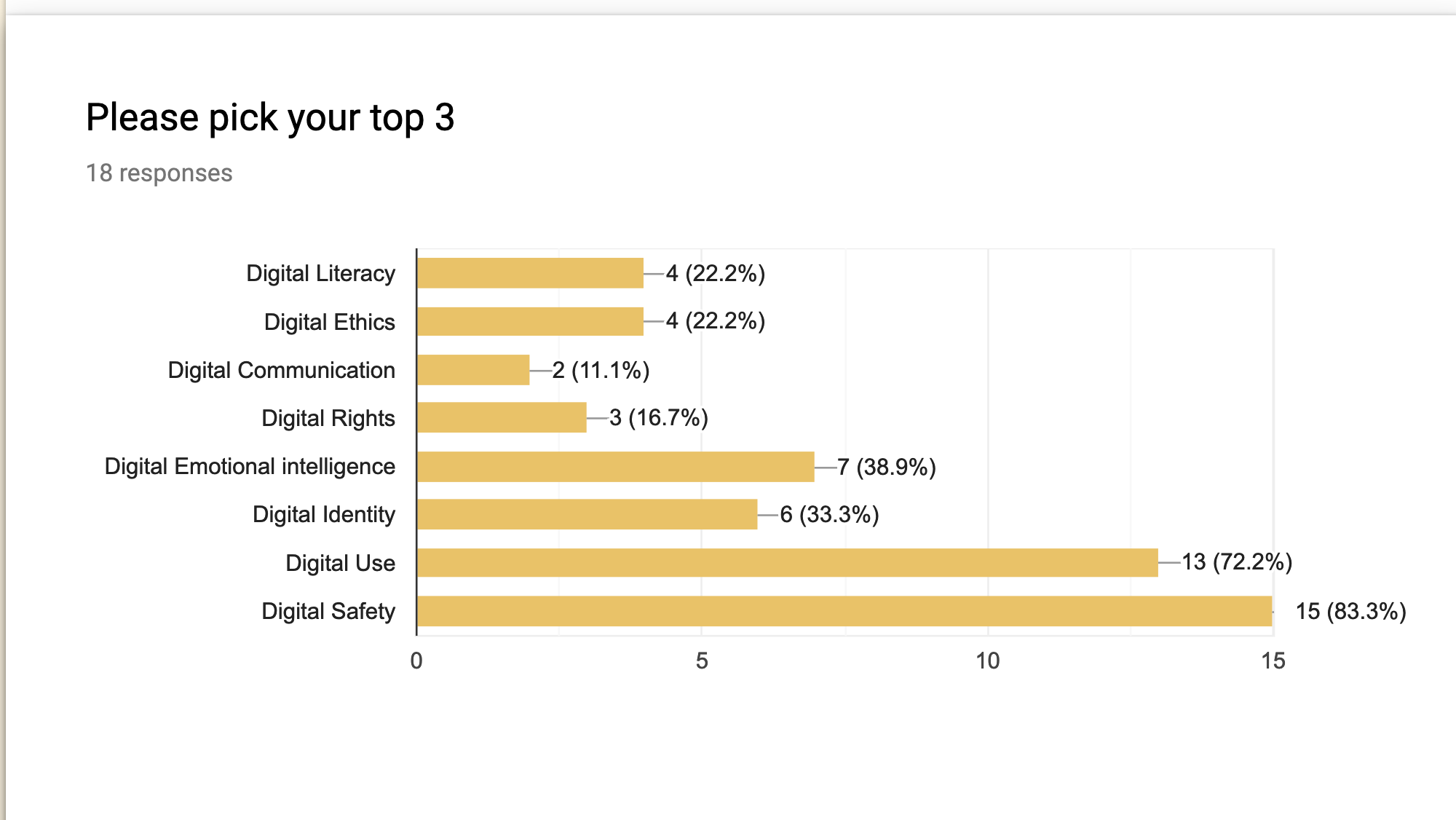
The above graph is one sample of several surveys done with Grade 5- 6 students asking them what areas of the DQ Framework they would like to learn and focus on. Interestingly, there was a clear pattern across several groups for Digital Safety as the highest priority (from the DQ Competencies.)
An important aspect of this is allowing student voice to actively guide the design of these digital fluency connections. They are identifying valuable needs and ensuring this open communication is key to making this shift meaningful to them.
Here are some examples of what digital fluency could look like, and what some schools are already actively creating. One example is giving high school students a LinkedIn account and spending time supporting what it means to have a public profile and how to curate a positive digital footprint compared to a personal social media footprint. Other schools are creating blended courses for parents on how to understand the difference between the pedagogic use of digital devices in schools and the challenges of a more open ended environment of digital device use outside of school in the home. Another example is having students develop public service announcements regarding malware and then coaching younger students on how to identify phishing emails and how to manage an antivirus app. Another is walking through the architecture of effective password creation and developing sustainable strategies to ensure a solid level of security in the students personal lives as a podcast. Or having students coach their parents through the privacy and security settings of their favorite app and create a how-to help screencast.
It is through these activities that participants build on a set of dispositions, skills and knowledge where they feel a sense of autonomy in addressing the complexities, challenges and opportunities of the digital ecosystems we are so intimately connected to.
The new year, 2022, at our doorstep will be even more intrinsically connected to cohabitation with AI and a continued dilution of the autonomy we have with our privacy. Scaffolding digital fluency as an essential part of the learning pathways provides a guide for students to shift their energies away from being passive digital consumers to active digital creators. Digital fluency provides a mindset to better understand the importance of the ethical responsibilities of digital creation and the implications of the digital ecosystems which permeate our lives, both visible and invisible. Ignoring this will just amplify a society of passive digital consumers, while eroding our free will.
John@beyonddigital.org
Sources-References
The Age of Surveillance Capitalism: The Fight for a Human Future at the New Frontier of Power by Shoshana Zuboff.” Goodreads, Goodreads, 15 Jan. 2019, https://www.goodreads.com/book/show/26195941-the-age-of-surveillance-capitalism
Asthana, Anushka, et al. “The Strange World of TikTok: Viral Videos and Chinese Censorship – Podcast.” The Guardian, Guardian News and Media, 7 Oct. 2019, https://www.theguardian.com/technology/audio/2019/oct/07/strange-world-tiktok-viral-videos-chinese-censorship
Written by Yuhyun Park, Founder and Chief Executive Officer. “8 Digital Skills We Must Teach Our Children.” World Economic Forum, www.weforum.org/agenda/2016/06/8-digital-skills-we-must-teach-our-children/.
DQ Framework: “What Is the DQ Framework?” DQ Institute, http://www.dqinstitute.org/dq-framework/.
“Coalition for Digital Intelligence.” Coalition for Digital Intelligence, www.coalitionfordigitalintelligence
a conversation with Glaucia Rosas @EduTec Alliance
Glaucia Rosas co-founder and Director of the https://edutecalliance.com/ invited me to sit down and share some reflections on her podcast about Educational Technology, Online Learning and juggling General Data Protection in a School setting.
a letter to COVID
Dear COVID,
It has been over 14 months since you first came to visit. Since then, you have single-handedly forced us into a global pandemic. As I sit here writing this letter, I think about how uncomfortable and complex you have made our lives. Without warning, you’ve challenged me and others to juggle unfamiliar levels of uncertainty. Challenging me and others with ambiguity and disquiet with no warnings.
You have no regard for who each one of us is. The intensity of your presence is felt by me, family, friends,colleagues, everyone. What scares me is your silence. Your unpredictability. That tenacious, invisible presence. I hear so much about you daily. I try to make sense of the absurd, and the fear: conspiracies, manipulations, divisions. I’m not sure what is what anymore.

You have left me confused and I am doing my best to navigate your presence. With hesitation, I keep looking at my social media feeds to help me understand the latest post about you. But the curated content makes me unsure of what is true, and what is a lie. Apparently the lie is true, but then I am told the truth is a lie. It’s so hard to wrap my head around it
I have shed many tears -more than I care to admit. It is the death, the pain, the relentless suffering you cause that hurts most. As you continue to show up unabated,I am humbled by all who care day and night, unselfishly, for those who have succumbed to you. The numbers are an uncomfortable, exponential statistic. Our arrogance with time and the little remorse you share in the limbo of the day. You are harsh!
You came right into my school without asking. You fell on us all, in the city, in the country, and you scared us into a lock down. My class and I avoided you the best we could with social distancing, disinfectants and curfews. My class flipped to emergency learning, tried working online, then moved to a hybrid. I looked up and suddenly we were all in each others’ homes, living rooms, and kitchens. I spent hours, coffee mug in hand, late at night, adjusting, redesigning my lessons. I would get memos from the building Principal saying it wasn’t enough, her expectations constantly changing as a disgruntled Board Member breathed down her inbox. I taught my class about “Zoom Fatigue” synchronously and asynchronously, and still a parent emailed me in ALL CAPS about learning loss.
Even though you kept coming back in waves, I did find a sliver of time to pause. It was a minute. I looked around. I could hear the sighs of my colleagues,and suddenly the invisible became visible. Why do we have 16 tests for this grade? Should I even do this online? Flipgrid or padlet? I recognized that well being is about more than a bottle of wine with Netflix. I saw friends anxious, alone, and sad trying to connect to something real, something tangible. . My credit card spent more time online than in my wallet. Constant change, in all shapes and forms, is the new normal. Everyday, I got creative and convinced myself to be positive and hopeful. I threw away my old box of lessons and leaned on my PLN for inspiration in breakout rooms. I took another pause, found more time to listen and learn. My class raised their hands and whispered through their masks “voice and choice.” I played with the idea, it felt right – why would I go back to the past?
I’m not sure what your plans are now, or how much longer you’ll be around. But I will turn the page, because I know looking back makes little sense. I will start at zero and forget the past as much as I can. So much I have learned, so much I can do better at, so much is far more important than I ever imagined. You gave me a moment to think about balance, respect, dignity, community. Okay I get it, this is not your last visit. I will not ignore things anymore: the hurricanes, the droughts, and floods. I am not going to ask you for details, or even predict the best next step. I realise where we are, and where I need to go.
I am not sure why I am even writing all this to you, but in the unexpected manner your visit fell on us all, I realise now we cannot continue the way we have been. This is clear to me and I understand this.We don’t have a choice. So now, as I finish this letter, it is up to me to step up and reimagine tomorrow anew.
Your sincerely,
 Beyond Digital
You must be logged in to post a comment.