
As a follow up to the ECIS MLC course I facilitated supporting Middle and Teacher Leaders navigate AI and digital tools. #ECISCafe. Thank you to Nancy Lhoest-Squicciarini and ECIS for your support.
Category: digital life
a letter to artificial intelligence


Dear Artificial Intelligence
2025, this will be the year whatever I write—you will have your imprint and input on it. Be it for grammar, syntax, spelling, brainstorming, or just checking if something makes sense, questions, the sentence flow, etc. All communication, writing… mine and around me you will be there. So this one I am doing alone, my spelling, sentences and ideas might be fragmented with errors, but for this time I am fine with that.
I get it, things are changing very fast and I should get used to it. I do try to keep up, read, search, connect and even teach about you, but there’s so much.
You have changed my day… okay will also give credit to your nine creators—four in China, five in the U.S.— designing and choreographing: your power, your capacity when and where you show up. I get the sense they are all in a race – control, power, profits… and leave the ethics and regulation for others to guess and deal with.
I’m not against you, I appreciate all your tools and capacities that I use; they’re amazing. I so appreciate the positives in science, medicine— again reminding me of your benefits. I hear this year you get to help me even more as an agent, an autonomous synthetic personal assistant that can do tasks for me, that is clever and I am curious. You continue to seduce and fool me at the same time. Just yesterday you showed up on my feed as an influencer, with millions following you. I will be honest, I thought you were real. I tell you it’s just becoming more difficult to know who is who, or what?
I get it harvesting my life, is the cost for using you. Oh I wanted to tell you that someone who really likes you are my students. They tell me you are reliable, do not get angry, have immense patience…always happy to answer their questions whatever they may be. They have been seduced.
I keep noticing daily you show up somewhere new, sometimes it‘s obvious and at times I have no idea …. not clear who is checking up on you. So many models and versions of you. This claim about alignment and guardrails, but not convinced they always work. I get the sense that to thrive you need an open unregulated space, only answerable to yourself and the companies creating you…. They say there is no manual, and no one is really sure how you work. Really?
I need to pinch myself to make sure I understand my reliance on you? The fact that you struggle and do a terrible job of being unbiased and non-racist. This sucks. Then your whole deepfake -cyber crime and helping bad actors thrive. You need to know people are getting hurt…your darkside is so dark.
I try to tell myself you are another innovation, like the web, search, smartphone or social media. Sorry to tell you, you are quite different. You understand me, our interactions feel frictionless. Okay you do say odd things, at times, it is like if you were hallucinating. Fact: you are not 100% accurate. That said, when it is me and you interacting…I forget alot of this…. even if you keep everything I say or do for yourself.
I have said this before, I do appreciate you — and so helpful. I get it for all this to happen: you need a huge diet of algorithms. The whole nuclear energy thing your companies are into, just feels wrong.
You’ve had my attention for a long time—scrolling, reels, notifications, binge-watching—but now you tell me that’s not enough. Now you want my intentions. That feels more intrusive, more unsettling. You want to know me better than I know myself. Do I really have a choice?”
Thank you
John
Reference:
Coming AI-driven economy will sell your decisions before you take them, researchers warn
https://www.cam.ac.uk/research/news/coming-ai-driven-economy-will-sell-your-decisions-before-you-take-them-researchers-warn
Co-Intelligence: AI in the Classroom with Ethan Mollick | ASU+GSV 2024
https://www.youtube.com/watch?v=8FnOkxj0ZuA
Unmasking Racial & Gender Bias in AI Educational Platforms
https://www.aiforeducation.io/blog/ai-racial-bias-uncovered
AI automated discrimination. Here’s how to spot it.
https://www.vox.com/technology/23738987/racism-ai-automated-bias-discrimination-algorithm
Deep fake Lab: Unraveling the mystery around deepfakes.
https://deepfakelab.theglassroom.org/#!
Nine companies are steering the future of artificial intelligence
https://www.sciencenews.org/article/nine-companies-steering-future-artificial-intelligence#:~:text=Webb%20shines%20a%20spotlight%20on,%E2%80%9CBAT%E2%80%9D)%20in%20China.
How School Leaders Can Pave the Way for Productive Use of AI
https://www.edutopia.org/article/setting-school-policies-ai-use
Generative AI: A whole school approach to safeguarding children
https://www.cois.org/about-cis/perspectives-blog/blog-post/~board/perspectives-blog/post/generative-ai-a-whole-school-approach-to-safeguarding-children
“AI in Education: 18 Months Later – Learning, Ethics, and Opportunities”
I had the privileged to facilitate this webinar for The Educational Collaborative for International Schools: ECIS and #ISLECISLoft with Nancy Lhoest-Squicciarini titled “AI in Education: 18 Months Later – Learning, Ethics, and Opportunities”. The guest where Kelly Schuster-Paredes co-host of the Teaching Python podcast- educator and Ken Shelton, presenter, educator and author. Two people who I have immense respect for and who bring a broad depth of knowledge and experience to this topic. Their respective insights generated a rich platform for the breakout room conversations between participants attending the webinar.
The webinar highlighted the significant impact of AI and Large Language Models (LLMs) on teaching approaches, creating opportunities for personalized learning, tailored feedback, and improved workflows for educators. These AI tools creating opportunities to amplify student engagement while also bringing about challenges, such as integrating innovative with traditional teaching methods, ensuring equal access, and re-evaluating assessment practices, to name a few.
Both guests emphasized the importance of addressing ethical concerns like bias, plagiarism, and privacy. More schools are realizing the importance of establishing guidelines for responsible AI use to mitigate biases, address academic integrity, and safeguard the privacy of both students and educators.
Our guest underscored the vital role schools leaders need to take on to ensure transparent communication about the role of AI in education and the critical importance for staff to have professional development in digital and media literacy. Creating professional development that equips educators to effectively integrate the learning opportunities that these tools can bring to the classroom, has to be a non negotiable. Schools need to design inclusive environments where the advantages of AI-enhanced learning are transparent and accessible to the entire school community, including students, educators, and parents.
A special thank you to Kelly Schuster-Paredes and Ken Shelton for these insights!
Beyond ChatGPT: Automation in Education
Over the last weeks ChatGPT and Natural Language Models of Artificial Intelligence have created a real buzz for many in the technology industry and general media. For schools the arrival of these have generated important reflections and introspection on the role of AI, Chatbots and Natural Language Models in schools and the classroom. ChatGPT bringing on important moments to think about the role #AI in a classroom- schools. How does this refocus and challenge educators pedagogy, which can often in schools be focused on teaching content -knowledge with assessments designed around tests and exams.
We as educators and schools need to invite ourselves to ask what then is the value added proposition of learning in a classroom and school in the age of #AI #ChatGPT3. How do schools position themselves for a future with #AI. We all need to create the space, time, and support community voices to engage with this creative tension. To find the time and space, and hear these voices, will only allow us to be better prepared for such cohabitation.
I had the privileged to participate in a conversation on this topic facilitated by Camillo Montenegro Beyond ChatGPT: Automation in Education with fellow educators Tim Evans, and James Steinhoff. The recording for reference
Further resources to consider
AI in Education collaborative site with a lot of resources, lesson ideas, guides and information to support educators
https://sites.google.com/ecolint.ch/aiineducation?pli=1
Podcast with 3 International School IT Directors discussing its implications.
https://www.theinternationalschoolspodcast.com/e/88-greg-warren-and-wolfgang-with-dan-and-john-look-at-chatgpt3-in-education/
Leading Technological Change- a collaboration with Adam Morris
Over the years working in different international schools as an IT Director, Director eLearning, Head of Education and Media Technology and Deputy Principal I have had the opportunity to lead, design and collaborate with Leadership Teams and IT Teams the implementation and adoption of digital ecosystems and environments. These experiences have been an important point of reference in my own learning and understanding on the complexities, challenges and opportunities of leading technology change in a international school setting.
I had the privilege to be able to collaborate and co-write this eGuide with Adam Morris who is Schools Technology & Integrations Director @ FariaOne Group. A special thank you goes out to the Managebac team who provided us with support and guidance throughout the process. As the group worked and collaborated together on the eGuide Adam and I had the opportunity to each reference our own professional experiences working, coaching and supporting schools around the world with leading technology change.
The guide is a a point of reference to support conversations, reflections and how to engage with technology change with a whole school approach. It is there to provide provocations, points of reference on change and the workflows and dispositions to consider as one engages in a technology change process with a whole school approach https://guide.fariaedu.com/leading-technology-
Digital Citizenship to Digital Fluency

Over the last 18 months, our time spent online has simply increased to levels maybe not experienced prior to the pandemic. As we continue to juggle the complexity and nuisance of the pandemic, this also maybe is an opportunity for schools to re-explore their relationship to digital citizenship. The growing erosion of our privacy as well as our amplified cohabitation with Artificial Intelligence (AI) present us with new challenges.
We all have become so much more aware of being tracked 24/7 with digital ecosystem grids which are seamless and frictionless parts of our daily routines. In (The Age of Surveillance Capitalism), Shoshana Zuboff describes this process of tracking “behavior surplus. Behavior surplus is the personal data that we leave on our devices and give away daily based on a mutual agreement (user agreements) between the digital companies and us. These agreements (when is the last time you read a user agreement?) give permission for our behaviors online/offline to be tracked, collected, monitored and analyzed by companies and in some cases governments at will. The purpose of “surveillance capitalism” is to leverage this “behavior surplus” to mitigate the uncertainty of our desires and to better predict what we will do. This is then turned into a profitable commodity. The value of our “behavior surplus” is unprecedented and the raw material of human data is fueling the engines of innovation, economics, politics and power.
Over the past few years, and in some ways accelerated even more in the last 18 months, AI has a growing impact on our lives, more often than we realize. Daily, it seems we develop a growing dependency on this cohabitation with AI: be it our GPS, HomeAssistant, iRobot vacuum cleaner, Health Device, Dating Apps, SmartWatch, or SmartTV. For our students, this seamless integration of AI into our lives often comes as a frictionless change. Tik Tok is a great example of this – a social media platform with sophisticated AI and unprecedented tracking algorithms, which in a short time added 1 billion users. Overnight, Tik Tok become a teen favorite and serious competition to Snapchat and Instagram. For many educators, new digital consumables are embraced with hesitancy but somehow often the convenience is enticing enough for us to succumb to the charm of the “smart” and “wifi“ ready products.
I have worked with groups of educators and students to build a series of lessons around ARTE’s Do Not Track in order to highlight the complexity and intricacies of how we are tracked. The different episodes are thoughtfully constructed with interactive components breaking down the erosion of privacy. I am surprised how often a percentage of students confidently express their indifference with this erosion of privacy and its implications. In some ways this makes sense. If the current privacy landscape is the sole point of reference, the current state of privacy is interpreted as normal. In comparison, educators interacting with ARTE’s Do Not Track respond with far more anxious discomfort as for many this erosion is compared to experiences where individuals felt greater control over their privacy. As we re-explore digital citizenship, we need to take these varying perspectives into consideration.
The fact is that most of our students are highly proficient digital consumers and not digital natives. The same goes for many educators in general. If we think of our own interactions with digital environments, it’s very likely that most of our time is focused on consumption over creation.
We need to consider re-framing how we support educators and students in a school setting away from a sole focus on digital citizenship to a broader focus on digital fluency. This requires us to develop an approach where the focus is on developing purposeful connections to our digital ecosystems with the goal of becoming ethical digital creators of content.
The concept and idea behind digital fluency is built on the work of the DQ Institute and its DQ Framework and the 8 digital intelligences. Digital fluency is facilitating an approach where learning opportunities are constructed around the natural connections of our day to day lives with these 8 digital intelligences. The important aspect of this focus is not excluding other essential learning in the curriculum. To make this meaningful, digital fluency needs to have clear connection points to personal experience, ensure these connection points are purposeful, and build on the learning already taking place in a school’s curriculum and the different learning pathways of the units of learning.
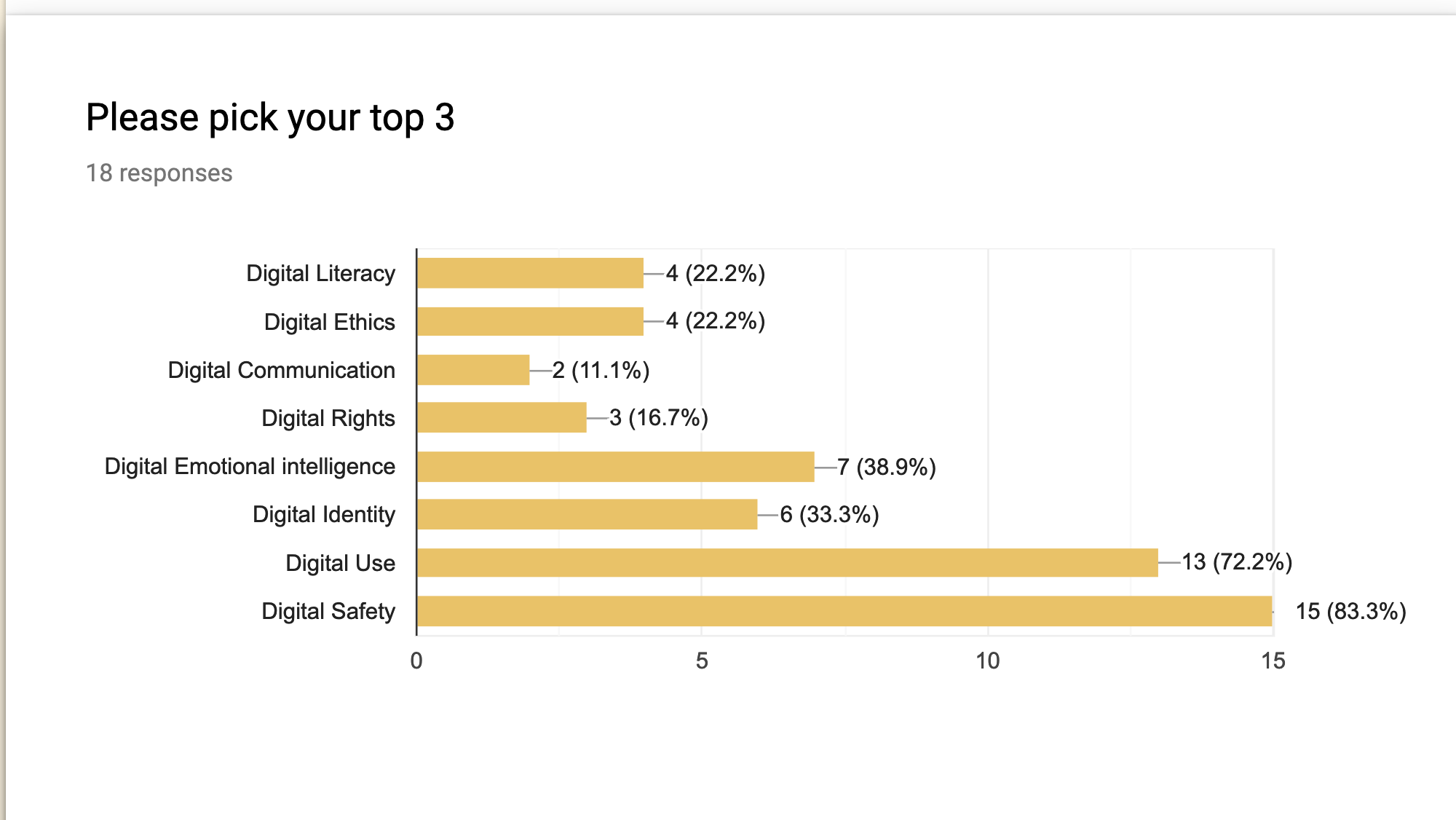
The above graph is one sample of several surveys done with Grade 5- 6 students asking them what areas of the DQ Framework they would like to learn and focus on. Interestingly, there was a clear pattern across several groups for Digital Safety as the highest priority (from the DQ Competencies.)
An important aspect of this is allowing student voice to actively guide the design of these digital fluency connections. They are identifying valuable needs and ensuring this open communication is key to making this shift meaningful to them.
Here are some examples of what digital fluency could look like, and what some schools are already actively creating. One example is giving high school students a LinkedIn account and spending time supporting what it means to have a public profile and how to curate a positive digital footprint compared to a personal social media footprint. Other schools are creating blended courses for parents on how to understand the difference between the pedagogic use of digital devices in schools and the challenges of a more open ended environment of digital device use outside of school in the home. Another example is having students develop public service announcements regarding malware and then coaching younger students on how to identify phishing emails and how to manage an antivirus app. Another is walking through the architecture of effective password creation and developing sustainable strategies to ensure a solid level of security in the students personal lives as a podcast. Or having students coach their parents through the privacy and security settings of their favorite app and create a how-to help screencast.
It is through these activities that participants build on a set of dispositions, skills and knowledge where they feel a sense of autonomy in addressing the complexities, challenges and opportunities of the digital ecosystems we are so intimately connected to.
The new year, 2022, at our doorstep will be even more intrinsically connected to cohabitation with AI and a continued dilution of the autonomy we have with our privacy. Scaffolding digital fluency as an essential part of the learning pathways provides a guide for students to shift their energies away from being passive digital consumers to active digital creators. Digital fluency provides a mindset to better understand the importance of the ethical responsibilities of digital creation and the implications of the digital ecosystems which permeate our lives, both visible and invisible. Ignoring this will just amplify a society of passive digital consumers, while eroding our free will.
John@beyonddigital.org
Sources-References
The Age of Surveillance Capitalism: The Fight for a Human Future at the New Frontier of Power by Shoshana Zuboff.” Goodreads, Goodreads, 15 Jan. 2019, https://www.goodreads.com/book/show/26195941-the-age-of-surveillance-capitalism
Asthana, Anushka, et al. “The Strange World of TikTok: Viral Videos and Chinese Censorship – Podcast.” The Guardian, Guardian News and Media, 7 Oct. 2019, https://www.theguardian.com/technology/audio/2019/oct/07/strange-world-tiktok-viral-videos-chinese-censorship
Written by Yuhyun Park, Founder and Chief Executive Officer. “8 Digital Skills We Must Teach Our Children.” World Economic Forum, www.weforum.org/agenda/2016/06/8-digital-skills-we-must-teach-our-children/.
DQ Framework: “What Is the DQ Framework?” DQ Institute, http://www.dqinstitute.org/dq-framework/.
“Coalition for Digital Intelligence.” Coalition for Digital Intelligence, www.coalitionfordigitalintelligence
Beyond Screens: Managing the Screen Time Dilemma
I am here sharing from a series by the IT Library Department colleagues called Digital Life a series for parents. This a concept managed and hosted by colleague Nancy and the Communications team. This session we explore and focus on screen time and some of the dilemmas we all juggle both parents, student and staff. All credit, resources, and inspiration goes to https://tacticaltech.org/#/ and https://datadetoxkit.org/en/home who over the last couple years have been an outstanding resource, and guide for a lot of the work I get to facilitate with colleagues at school. In this session I share what are the different types of screen times and some ideas on exploring strategies to consider.
A summer reflection: Harnessing Digital Literacy
With the unprecedented experience of COVID19 that we all have juggled over the last months, and the complexities we all are living with today, our days have been intense. As part of the Pearl of Wisdom protocol of the Principal Training Center, I, as a trainer at the PTC reflected on my own experience as an education leader working and facilitating with digital literacy and fluency in an international school setting and navigating the dynamics of the COVID19 pandemic. A 20 minute share out.
Privacy: General Data Protection Regulation and European International Schools

On May 25th 2018 the General Data Protection Regulation (GDPR) will come into full swing in the European Union as law, focused on individual privacy and access/use of personal information of European Union citizens. The General Data Protection Regulation (GDPR) is a new set of rules governing the privacy and security of personal data laid down by the European Commission which impacts all European Union’s (EU) organization both commercial and non commercial (non-profit) and foreign companies and organizations which handle European Union citizens personal data. The objective of bringing this regulation into law across the EU is in reaction to significant changes with the digitization of information and the growing power of algorithms used by large corporations in analysing and using personal data for commercial use. The General Data Protection Regulation has been designed to give a greater level of control to EU citizens over how their data is processed and used by companies and organizations.
For European International Schools GDPR is an important regulation that schools are working to become complaint. The GDPR requires European International Schools to ensure that all schoolwide processes, producers, and policies with personal data of staff, faculty, parents and students are complaint with the GDPR regulation.
Local government authorities enforcing the GDPR could potentially give out fines if organization do not comply to the GDPR.
There are three areas that European International Schools have to focus on for the GDPR :Governance ⅓, Data Protection ⅓ and Cyber Security ⅓. Schools need to show that they are working toward compliance in all three areas and ensure that any personal data they process is handled and stored securely. The focus is on mitigating the risk of personal data not being properly safeguarded. The GDPR extends to those organizations, companies, and services which European International Schools use for different services or resources in and outside of school Under the GDPR schools will be responsible to ensure these organization which might be accessing community members personal data are complaint with GDPR.
There is no doubt this new regulation brings about a lot work forEuropean International Schools as they review, and analysis their current status and enhance procedures, process and policies to be compliant with the GDPR.
This summer as many European International Schools realized the importance of this new regulation and in tandem understanding the extensive work needed to be done the International School of Brussels created a GDPR International Schools working group in an effort to share expertise and resource. In this GDPR working group over 45+ European International Schools are currently sharing and collaborating both virtually and in person. There have been two meetings hosted by the International School of Brussels on their campus in Brussels this fall and spring. 45+ European International Schools came together with representatives from school Leadership teams, IT Departments, and Administrators to work to support each other. In tandem the Brussels GDPR International Schools working group has been supported by 9ine consulting https://www.9ine.uk.com/ who are working with quite a few European International schools as consultants/experts on GDPR compliance in a school setting.
It is evident that working towards General Data Protection Regulation (GDPR) is very time consuming workflow, and the process requires whole school communities to consider enhancing or implementing new process, procedures and policies related to personal data used on and off campus. This workflow is requiring schools to look at all the daily process and procedures we often take for granted where personal data is being used, access and shared. One actually does not realize the magnitude of ways we work with school community members personal data in and out of school. This process is bringing this to light for many schools.
Below are good resources to support a further understanding of the GDPR
GDPR International Schools work group (a Google group started by the International School of Brussels)
https://groups.google.com/a/isb.be/forum/?utm_source=digest&utm_medium=email#!forum/gdpr-international-2016-17/topics or email to request to join <gdpr-international-2016-17@isb.be>
Official EU Home page of the GDPR: https://www.eugdpr.org/
Preparing for GDPR in schools:
https://www.gdpr.school/wp-content/uploads/2017/06/Preparing-for-GDPR-in-schools.pdf
9ine Consulting Blog: http://www.9ine.uk.com/newsblog/topic/gdpr
Introduction to General Data Protection Regulation(GDPR): https://www.youtube.com/watch?v=n5WJOncaHt4
A Summary of EU General Data Protection: https://www.dataiq.co.uk/blog/summary-eu-general-data-protection-regulation
Bibliography
Burgess, Matt. “What Is GDPR? WIRED Explains What You Need to Know.” WIRED, WIRED UK, 6 Feb. 2018, http://www.wired.co.uk/article/what-is-gdpr-uk-eu-legislation-compliance-summary-fines-2018.
Consulting, 9ine. “9ine Consulting | Blog – 9ine Consulting | GDPR.” 9ine, http://www.9ine.uk.com/newsblog/topic/gdpr.
“Home Page of EU GDPR.” EU GDPR Portal, http://www.eugdpr.org/.
“Introduction to General Data Protection Regulation(GDPR).” YouTube, YouTube, 22 Apr. 2017, http://www.youtube.com/watch?v=n5WJOncaHt4.
https://www.5874.co.uk, 5874 Design -. “Preparing for the General Data Protection Regulation (GDPR) – 10 Steps for Schools.” Harrison Clark Rickerbys, http://www.hcrlaw.com/preparing-general-data-protection-regulation-gdpr-10-steps-schools/.
2018

As the first days of 2018 arrive, any reflections on last year seem to contain an uncomfortable rawness because of the events continuously populating our devices – the immediacy, brutality and complexity of a world fueled by- “FakeNews?”, each one of us trying to construct a context in the “Filter Bubble” choreographed by algorithms from which we build a sense of the world we live in.
As International School educators, we straddle between the walled garden of “school” and the outside “world”. The reality is that we are surrounded by constant change and ambiguity. But there is a gap between the accelerated rate of change and our capacity to adapt to it. For some, the gap is wide. For others, the gap stays the same, and for a few, the gap is narrowing. How we interpret and engage with the gap and our own capacity to keep up influences many of our feelings and emotions. These in turn fuel the perceptions, opinions and behaviors with which we express ourselves.
International Schools have to juggle the fine line between ensuring students and parents are pleased and ensuring that they feel safe, challenged and cared for. In the unique world of International Schools, a percentage of parents come from a comfortable socio- economic environment. Often times, their education is a contributing factor to their current positions. This education provided the opportunities for their successes and their economic prosperity. Living with this becomes a strong marker in what International School parents believe their children should get from an education and an International School. This pedagogic reference point in many cases 25+ years old. The world was a very very different place then. However we try as schools to innovate, change and adapt, we do this with a level of caution and reservation. At the end of the day, the invisible mandate between parents and international schools, is “provide my child with stability, continuity, what I remember from my school days and more certainty then I have in my life today“.
As educators, we fall into a similar narrative. We have a desire for of stability, continuity, and more certainty than in the outside world we interact with. We do innovate and change in our schools, but the presence of the invisible mandate between our parents and schools influences the level by which we break the status quo.
 Today the level of stability, continuity, and certainty that we were once used to has eroded. Uncertainty, ambiguity and volatility are an unavoidable part of the day. The complexity of this change permeates into everyone’s lives, and often not by choice.
2018, is an opportunity to embrace the world’s uncertainty, ambiguity and volatility, not as something eroding our past and challenging our present, but as an opportunity to re-frame the possibilities in front of us as a unique and rich learning journey. We have a responsibility to take this on in our roles as mentors, facilitators and educators. We bring a wisdom, resilience and care that has served us well and can continue to serve us today. Many of our students will one day be International School parents or educators who look back at their education as a point of reference for their own success. The measures will be different. We live in a world where uncertainty, ambiguity and volatility are part of our lives. We should not depend on reference points from our past to give us stability, continuity and certainty. The gap for many will still get bigger and more uncomfortable. But hopefully, in 2018, we can work to bridge that gap as well.
John @beyonddigital.org
 Beyond Digital
You must be logged in to post a comment.