
Well-being has been an important part of our respective experience living and juggling the uncertainty of managing the Global Pandemic COVID19. The pandemic has for many created new stresses as part of the day, that are ambiguous, at times volatile with uncertainty. Carlos Davidovich and I explore the creative challenges of living during the COVID pandemic and how we each manage the challenges of the pandemic differently. Carlos shares his expertise on Neuro-management on known understandings of how the brain works and how we might consider understanding Well-being in this context. This recording is with video as we both prepare for a live session April 1, 2021 to support colleague and friend Nancy Lhoest-Squicciarini who hosts monthly the International School of Luxembourg Virtual Learning Lofts (#ISLLoft) which I have the privileged to co-facilitate with Nancy sometimes.
Category: International School IT
Online Learning – What Does The Research Say?
Every month as the Head of Education and Media Technology @ ISL, the IT Library team hosts virtual digital life series focused on an aspect of digital life that we all juggle at work and home. These digital life series facilitated by the librarians, digital learning coaches or myself. In this session I unpack some of the research regarding online learning and how schools are engaging with this.
Beyond Screens: Managing the Screen Time Dilemma
I am here sharing from a series by the IT Library Department colleagues called Digital Life a series for parents. This a concept managed and hosted by colleague Nancy and the Communications team. This session we explore and focus on screen time and some of the dilemmas we all juggle both parents, student and staff. All credit, resources, and inspiration goes to https://tacticaltech.org/#/ and https://datadetoxkit.org/en/home who over the last couple years have been an outstanding resource, and guide for a lot of the work I get to facilitate with colleagues at school. In this session I share what are the different types of screen times and some ideas on exploring strategies to consider.
A summer reflection: Harnessing Digital Literacy
With the unprecedented experience of COVID19 that we all have juggled over the last months, and the complexities we all are living with today, our days have been intense. As part of the Pearl of Wisdom protocol of the Principal Training Center, I, as a trainer at the PTC reflected on my own experience as an education leader working and facilitating with digital literacy and fluency in an international school setting and navigating the dynamics of the COVID19 pandemic. A 20 minute share out.
Privacy: General Data Protection Regulation and European International Schools

On May 25th 2018 the General Data Protection Regulation (GDPR) will come into full swing in the European Union as law, focused on individual privacy and access/use of personal information of European Union citizens. The General Data Protection Regulation (GDPR) is a new set of rules governing the privacy and security of personal data laid down by the European Commission which impacts all European Union’s (EU) organization both commercial and non commercial (non-profit) and foreign companies and organizations which handle European Union citizens personal data. The objective of bringing this regulation into law across the EU is in reaction to significant changes with the digitization of information and the growing power of algorithms used by large corporations in analysing and using personal data for commercial use. The General Data Protection Regulation has been designed to give a greater level of control to EU citizens over how their data is processed and used by companies and organizations.
For European International Schools GDPR is an important regulation that schools are working to become complaint. The GDPR requires European International Schools to ensure that all schoolwide processes, producers, and policies with personal data of staff, faculty, parents and students are complaint with the GDPR regulation.
Local government authorities enforcing the GDPR could potentially give out fines if organization do not comply to the GDPR.
There are three areas that European International Schools have to focus on for the GDPR :Governance ⅓, Data Protection ⅓ and Cyber Security ⅓. Schools need to show that they are working toward compliance in all three areas and ensure that any personal data they process is handled and stored securely. The focus is on mitigating the risk of personal data not being properly safeguarded. The GDPR extends to those organizations, companies, and services which European International Schools use for different services or resources in and outside of school Under the GDPR schools will be responsible to ensure these organization which might be accessing community members personal data are complaint with GDPR.
There is no doubt this new regulation brings about a lot work forEuropean International Schools as they review, and analysis their current status and enhance procedures, process and policies to be compliant with the GDPR.
This summer as many European International Schools realized the importance of this new regulation and in tandem understanding the extensive work needed to be done the International School of Brussels created a GDPR International Schools working group in an effort to share expertise and resource. In this GDPR working group over 45+ European International Schools are currently sharing and collaborating both virtually and in person. There have been two meetings hosted by the International School of Brussels on their campus in Brussels this fall and spring. 45+ European International Schools came together with representatives from school Leadership teams, IT Departments, and Administrators to work to support each other. In tandem the Brussels GDPR International Schools working group has been supported by 9ine consulting https://www.9ine.uk.com/ who are working with quite a few European International schools as consultants/experts on GDPR compliance in a school setting.
It is evident that working towards General Data Protection Regulation (GDPR) is very time consuming workflow, and the process requires whole school communities to consider enhancing or implementing new process, procedures and policies related to personal data used on and off campus. This workflow is requiring schools to look at all the daily process and procedures we often take for granted where personal data is being used, access and shared. One actually does not realize the magnitude of ways we work with school community members personal data in and out of school. This process is bringing this to light for many schools.
Below are good resources to support a further understanding of the GDPR
GDPR International Schools work group (a Google group started by the International School of Brussels)
https://groups.google.com/a/isb.be/forum/?utm_source=digest&utm_medium=email#!forum/gdpr-international-2016-17/topics or email to request to join <gdpr-international-2016-17@isb.be>
Official EU Home page of the GDPR: https://www.eugdpr.org/
Preparing for GDPR in schools:
https://www.gdpr.school/wp-content/uploads/2017/06/Preparing-for-GDPR-in-schools.pdf
9ine Consulting Blog: http://www.9ine.uk.com/newsblog/topic/gdpr
Introduction to General Data Protection Regulation(GDPR): https://www.youtube.com/watch?v=n5WJOncaHt4
A Summary of EU General Data Protection: https://www.dataiq.co.uk/blog/summary-eu-general-data-protection-regulation
Bibliography
Burgess, Matt. “What Is GDPR? WIRED Explains What You Need to Know.” WIRED, WIRED UK, 6 Feb. 2018, http://www.wired.co.uk/article/what-is-gdpr-uk-eu-legislation-compliance-summary-fines-2018.
Consulting, 9ine. “9ine Consulting | Blog – 9ine Consulting | GDPR.” 9ine, http://www.9ine.uk.com/newsblog/topic/gdpr.
“Home Page of EU GDPR.” EU GDPR Portal, http://www.eugdpr.org/.
“Introduction to General Data Protection Regulation(GDPR).” YouTube, YouTube, 22 Apr. 2017, http://www.youtube.com/watch?v=n5WJOncaHt4.
https://www.5874.co.uk, 5874 Design -. “Preparing for the General Data Protection Regulation (GDPR) – 10 Steps for Schools.” Harrison Clark Rickerbys, http://www.hcrlaw.com/preparing-general-data-protection-regulation-gdpr-10-steps-schools/.
Behavior Design – Learning2 Talk Europe 2017
To see all the L2Talk’s @learning2 # learning2 got to this link
Puppets on a string

The post is inspired by a L2talk I did at the Learning2 Europe conference in Warsaw.
“every storyteller has a bias – and so does every platform”- Andrew Postman “My Dad Predicted Trump in 1985 – It’s Not Orwell, He Warned, It’s Brave New World.” The Guardian. Guardian News and Media, 02 Feb. 2017
I am an addict. Are you too? Don’t you hate it when you can’t find your phone, and a friend has to call it. Maybe the first thing you did this morning was check your phone and the last thing you did today was check your phone. Think of it, we walk and text, and even drive and text. Have you had this happen, you are in a social situation and you go the bathroom to check an update. You are standing on a street corner and suddenly realize you are on your phone swiping at it, unconsciously. Then there is the feeling you get when you post a picture on a social media feed. The “likes” start coming in. It feels good, really good, and then you check back and back. You post an update and there no “likes”. You start wondering to yourself what is going on?

I am sure you’ve heard about B.J Skinner’s rat experiment. The first rat had a lever in its cage, and every time it hit the lever food would come out. The second rat in the same set-up, hit the lever and nothing came out, no food. The third rat, same set-up, when it hit the lever a little food came out, then nothing, and then a lot, and then nothing again. The third rat developed an addiction. It quickly realized as long as it hit the lever it had a chance of getting some food. This is called the principal of variable rewards. That feel good feeling, the dopamine rush. Behavior design as explained in this article (Scientist who make our apps addictive by Ian Leslie 1843 Economist) is a critical part of every app development. Tech companies employ behavior economist, psychologist, and psychiatrists in the creation, design and curation of our apps ecosystems to ensure we keep coming back.
So many of our interactions with devices are subconscious. In Eric Pickersgill thought provoking photos series “Removed” (do spend some time on the link) he highlights the idea of being alone together as Sherry Turkle so aptly describes in her book Alone Together. We are often physically together with another person in a space sometimes even intimately but our mind’s burrowed in a phone.
As adults, we are quick t0 point the finger at kids for not being able to manage their screen-time. Think of this, the first time an infant will interact with a digital device is watching a parent using one. What does it feel like for a child in a pram looking up at their parent to only see a blank expression immersed in their smartphone. The dinner table conversation interrupted by parents checking work emails. Mary Aiken in her book “ The Cyber Effect” states we are asking the wrong question. Mary Aiken writes “We should not be asking at what age is it appropriate to give a digital device to an infant, but be asking the question when is it appropriate for an adult to interact with a digital device in front of an infant.”
A good example of behavior design is Snapchat and the new feature “streaks“. The idea of streaks if you have a dialogue with a friend over 24 hours and you continue this over days, a flame emoji shows up. In tandem a number counting your interactions keeps tally. Should one of you stop posting, an hour glass shows up giving you a heads up that the streak will disappear if you do not stay on. For adolescent’s social media relationships can be a gauge of their social capital. Streaks adds a layer of complexity to the interactions.
I am not against digital devices. I have been working in Education Technology as a coach, coordinator, IT Director and Director of eLearning for over 20 years. I love the seamless and frictionless experience of our digital environments.

Do we want to end up being puppets pulled by the strings of choreographed digital ecosystems which we do not control?
I think it is important to understand schools are most likely the last place where children interact with digital devices with balance and pedagogic purpose. We cannot take this for granted.
If we ignore behavior design we will loose something. Free will. I and you do not want to lose this.
John @ http://beyonddigital.org
=
Hal, is in the house.

A colleague of mine and her Kindergartners were busy exploring where an egg comes from. “Was it born like a baby? Does it grow on its own? Where do they come from? Different perspectives and ideas were shared enthusiastically. The children discussed and challenged each other with their theories. At the end of the activity, one child turned to her partner and said, “when I get home, I’ll ask Siri for the answer.” A routine response in our classrooms? Or an important moment to understand that artificial intelligence (AI) has embedded itself in our day to day lives? For a generation of children who have been raised on iPads and Siri, AI – with a name and voice like a human – is as ubiquitous as any other technology.
AI is a tool that learns, anticipates and predicts. It provides us with instantaneous information or completes routine tasks remotely. The Amazon Echo and Google Home, two new devices that have recently gained traction, have begun to enter the home as personal assistants. The Echo and Home are two of many voice-activated AI assistants that tap into vast artificial intelligence networks. They aggregate information based on our digital footprints and predict our habits based on a learning algorithm that engages continuously with the data we share on our digital devices.
A shift has occurred in our relationship with AI and the impact is profound. It is the seamless adaptation of AI into our lives – a frictionless experience that is slowly making us dependent on this predictive technology. This new relationship meets our unique taste and needs, and only gets better the more it knows about us. Over time, this is changing the way our brain functions when interacting in the digital world. This short video by AcademicEarth.org -“ Cognitive Offloading,” is a reminder of the neurological changes AI is having on our learning. We collectively feel more and more comfortable subcontracting out tasks to AI. The term ” let me google this” is an example.
For educators, this shift is showing up in our classrooms informally and in some instances invisibly. Artificial intelligences are important elements of the devices which exist in our school tool kits. These include mobile devices, apps, browsers, search engines, smartwatches, and more. Writer and professor Jason Ohler asks an important question in his article “Bio-Hacked Students On the Outer Edge of Digital Citizenship”. How should we, as educators, shift the curation of a scholastic experience when students come to the classroom with embedded or wearable artificial intelligences? This alters the value of the commodity of knowledge in the classroom and highlights a potentially new hierarchy where AI supplements a user’s expertise. Suddenly, we have 24/7 access to predictive and anticipatory information which has the potential to disrupt the independent learning experience of a typical classroom. In his article “Artificial intelligence is the next giant leap in education“, Alex Wood reflects on the role AI could play in education.
Coming to terms with these exponential changes takes time to digest. As educators, we need to understand that engagement and critical thinking are vital components of education, especially as AI shifts the classroom narrative. The ethical issues which surround these exponential changes are here now. The complacency that schools engage with in the discourse of what it means to be in a world dominated by AI is a tension we cannot ignore.
What will a world look like when companies can remotely delete pictures and videos which do not fit a predefined perspective fueled by an AI? Danny Yadron questions this in his article “Apple gets patent for remotely disabling iPhone cameras.” What will a world look like when you scan a person’s image on the street and instantly receive their aggregated digital profile? In Shawn Walker”s “Face recognition app taking Russia by storm may bring end to public anonymity ” he shares the dynamics of the “FindFace” application, reminding us of the reality at our doorstep.
As educators, we have a unique opportunity to design curriculums around the narrative of artificial intelligence. We need to be encouraging our students to not only be good digital citizens but proactive digital leaders who understand the complexity of a world fueled by artificial AI. Schools should promote the skills and inquiry mindsets which provide students with the capacity to harness the power and opportunities of AI and not become complacent with the technology. Ultimately, we want our students to be active leaders and architects of AI’s continued growth. As educators, we have a responsibility to ensure our students have a working understanding of how to navigate a complex and changing world fueled by artificial intelligence for the good of future generations.
John@beyonddigital.org
Living in a “GAFA” world.
Think of what Google, Apple, Facebook and Amazon services and products you use daily. How much are they a vehicle for communications, work, social life, purchases and tasks? How often do you connect to them? Count the number. How many? Surprised? Now, out of the 4 companies, how many do you use? Or do you not. The reality is that you probably use at least one, if not all of the four, very frequently.

Welcome to the “GAFA” (Google, Apple, Facebook, Amazon) world. The”GAFA” world is where most of humanity’s internet users and consumers work, communicate, socialize, learn, entertain themselves, and share, in services provided by one, two, three or all four of these companies: the “GAFA” grids.
We have become comfortable with “GAFA’” being part of our lives in multiple venues, and as a result, schools, educators, students and parents are investing significant amounts of monies into “GAFA”. It is an essential component of our ability to function at school and at home, and the collective convenience and seamless experience of “GAFA” intoxicates us.
In Terry Heick’s (@TeachThought) thoughtful article “How Google Impacts The Way Students Think”, he highlights how learners working in a Google ecosystem develop an appetite for a black and white information age. The expectation? Immediate answers, 24/7. The convenience of this immediacy creates an illusion of thinking, but actually disengages the user from deep critical thinking. It does this by simplifying the process of gathering information and giving the impression it is all connected.
In order to have a constant infusion of innovation and creativity, “GAFA” also hungers for start-up companies. By absorbing these companies, they are able to facilitate the pollination of ideas, products and services and enrich their ability to generate more seamless methods of connectivity. In this way “GAFA’s” largeness and versatility is engrained in all aspects of our lives
This innovation also provides “GAFA” with opportunities to tie our lives closer together with multiple platforms and venues in a frictionless environment. Examples of this reach are Amazon’s cloud service, which hosts large architectures of company websites, services, and databases, including the CIA’s; Google moving into the home with Nest and pursuing the development of artificial intelligence (Dark Blue Labs and Vision Factory); Apple’s acquisition of Affectiva, a company that specializes in emotion recognition, and investments in health apps and services; and Facebook’s expansion into virtual reality. Making its services ubiquitous, as with the “free wi-fi-with-check-in ”in hotels and small businesses. Its purchase of “Whatsapp” is another example of how a “GAFA” company spent billions on an innovative service.
The algorithms provide a treasure trove of information with which to understand our behavior, habits, aspirations and desires. In Raffi Khatchadourian’s article “We Know How You Feel”, we are reminded that the hunger for data is tied to a hunger for emotional interactions. In Shelley Podolyn’s New York Times article, “If an Algorithm Wrote This, How Would You Even Know?”, she highlights the level of sophistication of writing algorithms generating news articles and books. In tandem, the growth of “The Internet of Eyes“ in objects we interact with, as part of the “ Internet of Things.” brings about a new dynamic to data mining. It is a reminder that many of these algorithms being designed within “GAFA” play an almost non-negotiable role in our lives.
Many schools believe that their curriculum’s should allow for authentic connections to the world around them. What about “GAFA”? Should we as learners, guides, mentors, and facilitators highlight “GAFA”? Is this important? Should its presence be considered in our learning outcomes? To ignore “GAFA” is to create a disconnect with present changes that are reshaping all of our lives. It sidelines a reality that is the future. What does “GAFA” mean, to us, our schools, community and educational institutions? Schools have a responsibility to ensure this is part of the curricular discourse. We need to construct learning moments and scaffold time to pause, reflect, understand, explain and critically think about what it is to live in a “GAFA” world.
If personal privacy, independent thought, critical thinking, differentiation, balanced perspectives, mindfulness and our capacity to be unique are in our school’s mission, we need to address what it means to be curated by “GAFA”. Will we not lose an important aspect of humanity, if we continue to ignore “GAFA”?
P.S: Next time you are at a Starbucks drinking your coffee remember that the free wifi is a “GAFA” gift!
Disrupt Me!
Disruption for many people generates discomfort, shakes the status quo and breaks routines. We all have an emotional response to this process: for some hesitation, doubt, confusion, fear, anger, bewilderment, and for others excitement, rejuvenation, inspiration, motivation and energizing or a combination of the above.
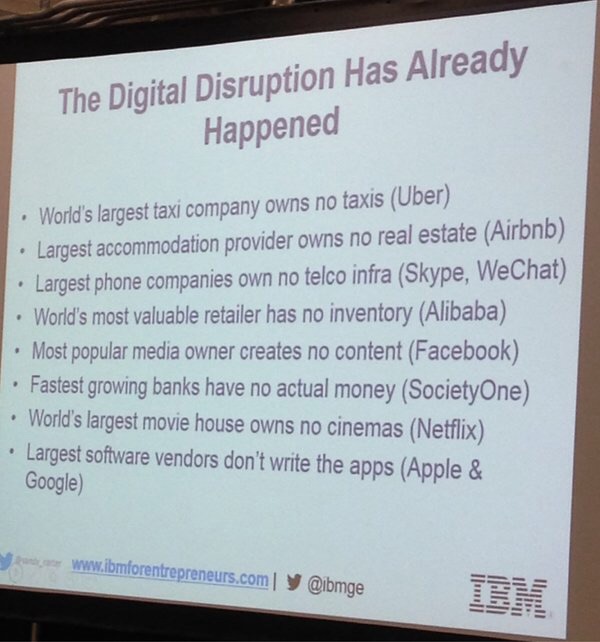
The Digital Disruption Has Already Happened” image on twitter challenged my own thinking, and as I unpacked this with a group of students we all had to take time to unravel what this meant to us. After a healthy discussion we came to a common understanding that each of these companies generated a “disruption” armed with ideas and models that completely reshape the economic contract of the business world. The disruption challenged a set of expectations, routines and structures, thus redefining what it means to provide a particular service. In the process, the relationship between worker, employer, customer and their social contracts was also redefined. As these models of disruption become part of our economic ecosystem, a whole new paradigm faces us. A good example of this process is featured in this article “The Last Kodak Moment?” (Economist)
As the students and I further discussed what this means to us here in the classroom, we started realizing a distinct disconnect between the objectives and outcomes of our learning in school and the reality that this image represents. There are two worlds working in very different realms with no clear bridge creating a meaningful authentic connection between them. As one student shared after seeing this video in class, “mmm I find it odd that we are not learning how to make these things in school, or understand how they work or maybe fix them.”
Yes, the world around us is changing rapidly, very rapidly, we know this, we are aware of this, we state this, and are impacted by this daily. However, our role is often that of the passive consumer, unconsciously sucked in by the addictive seamless convenience of the services these disruptions deliver. In our passivity and growing dependence we seem willing to sideline a more critical reflection of what this disruption is doing to us. The engines of this disruption: creativity, machine learning, algorithms, and innovation are driving the ecosystems which are quickly becoming non negotiables with our work and social flows. These disruptions are inevitable and not bad or good, they are part of today’s economic narrative that impacts us all locally and globally.
But in the bubble of “school” there is a sense that it is okay not to engage with this concretely, giving ourselves permission to continue focusing on learning objectives and outcomes tied to a past. As Michael Wesch shares in this TedTalk: From Knowledgeable to Knowledge-Able, what we teach, what we engage as “musts” as part of the learning contract are disconnected from the pressing realities surrounding us. This lack of authentic connection and scaffolding which should provide the skills and cognitive capacity to critically engage with the rapidly changing world are watered down to suit our own educational comfort zone and established routines, which have worked so well for us in the past.
Schools are keen to talk about teaching to students’ future and as George Couros share in his book ” Innovators Mindset”, its all our future and all of us need to understand and engage with it concretely, not just the kids. Education rhetoric is rich with 21 century skills terminology and on the surface we are okay to dabble with some ideas and changes, but not at the level where we truly have taken on a deep understanding as educators about what this disruption is doing to our world and how we can act as concierges of learning. We need to ensure our students are not simply consumers of the disruption but empowered creators and active participants of the disruption.
A disruption needs to occur in schools with professional development. In a video by Frank Barrett in the Harvard Business Review “To Innovate, Disrupt Your Routine” he highlights the importance of leaders ability to engage in a process where routines are disrupted to generate opportunities for creativity. As an example he uses the wonderful analogy of Miles Davis’s Kind of Blue album and the disruption he facilitated, disrupting routines which had the group enter a discomfort and then supporting them to create something new that changed the face of Jazz.
It is often the case, and I am generalizing here, that professional development in schools is focused on pedagogy framed by comfort zones that generate no disruption, learning framed with limited clear connections to the real world, lecture style delivery, and bulleted PowerPoints squeezed at the end of a long day of work. This dynamic can generate a level of disconnect, cynicism and passivity by participants, and dilutes the connection between what we teach and how we tie learning to be authentic and connected to the pressing realities surrounding us.
School leaders need to first disrupt their own professional development. They also need to be bold and challenge their own comfort zones. Through this act, we then experience first hand the process described by Frank Barrett in the Harvard Business Review, and will be willing to mentor leadership teams and faculty to go through a similar process with explicit support and care. If we are going to lead and disrupt our routines to engage in a process where we innovate and create then educators need time, space, support, empathy, and meaningful scaffolding. With this we build the capacity to disrupt their own thinking and internalize how they can take ownership with the process. We need to disrupt professional development learning outcomes, so as to be able to craft a learning narrative connected to a world driven by a new economic reality; one framed by creativity, algorithms, machine learning and innovation. Through this process we can then facilitate a culture where educators become active participants of the pressing realities surrounding us and lead and mentor learning with authentic and meaningful connections to the world of disruptions we are living in.
We cannot expect to authentically connect our students’ learning environments with the rich tapestry of the world of economic disruptions without giving ourselves permission to disrupt ourselves first and shift our professional learning discourse to unpack, synthesis, connect and craft learning outcomes that explicitly provide meaningful opportunities for us to make sense of constant disruptive change, and from there as concierges of learning, choreograph an authentic learning landscape for students. “Disrupt me!”
 Beyond Digital

You must be logged in to post a comment.